

DNI meaning medical refers to “Do Not Intubate.” It is a medical order that tells healthcare teams not to place a breathing tube in a patient’s airway or connect them to a mechanical ventilator if their breathing fails. A DNI order does not automatically mean “do not treat.” Oxygen, medications, and non-invasive ventilation like BiPAP may be provided. Other treatments, including antibiotics and comfort-focused care, can still be provided as needed. The choice depends on the person’s goals and the clinical situation. A review of DNR ethics makes the same core distinction: limiting resuscitation is not equivalent to stopping treatment.
A DNI order is about intubation and invasive mechanical ventilation. It is separate from a DNR order, which concerns cardiopulmonary resuscitation after cardiac arrest.
What does DNI mean in medical terms?
DNI meaning medical is straightforward, and it tells the care team not to place a breathing tube if the patient’s breathing fails. If a patient has a DNI order and can’t breathe well, doctors shouldn’t put a tube in. They should not insert a tube through the mouth or nose into the windpipe. This means the patient will not be connected to an invasive ventilator. The order doesn’t stop treatment before that point.
Reviews mention non-invasive respiratory support and tailored treatment as choices for DNI patients. The care team can treat a reversible cause of breathing trouble. They may provide oxygen, use medications, and consider non-invasive respiratory support. This is done if it aligns with the patient’s wishes.
The real question isn’t just “DNI or not.” It’s which treatments the patient wants, for which conditions, and for how long.
DNI and DNR conversations often go wrong when doctors treat CPR and mechanical ventilation as if they were one single decision, instead of two separate ones.
What is intubation?

Intubation is a procedure in which a clinician places a breathing tube into the trachea. In an emergency, the usual sequence is broadly:
- The patient receives medication to reduce pain, anxiety, awareness, or muscle movement when clinically appropriate.
- The clinician uses specialized equipment to visualize the airway and guide the tube into the trachea.
- The tube is secured and connected to a mechanical ventilator.
- The ventilator delivers breaths or breathing assistance while the underlying problem is treated.
A ventilator helps a person breathe when the lungs, breathing muscles, or brain cannot do so well enough. Doctors may remove the breathing tube when the patient can breathe safely without the ventilator. This is called extubation. Some people need a ventilator for a short time, while others may need it longer. This possibility should be discussed before treatment, especially in people with long-term lung disease.
Intubation can save a life, but it is an invasive procedure. It may sometimes cause problems such as injury to the teeth, throat, vocal cords, or airway.
Other possible risks include bleeding, aspiration, complications from the ventilator, and difficulty removing the tube.
These risks do not mean intubation is wrong; they are factors patients and families should consider when making a decision.
What a DNI allows and prohibits
| Treatment or Intervention | Usually Allowed with DNI? | Simple Explanation |
| Oxygen | Yes | Oxygen may help with low oxygen levels or make breathing more comfortable. |
| Medicines | Yes | Medicines can treat problems such as infection, narrowed airways, extra fluid, anxiety, or pain. |
| BiPAP or CPAP | Often yes | These machines support breathing through a mask, not a breathing tube. They may be used if the patient can tolerate them and wants this type of treatment. |
| Comfort care | Yes | Doctors can still treat breathlessness, pain, anxiety, and other symptoms. |
| CPR after the heart stops | It depends | DNI does not automatically mean no CPR. CPR requires a separate DNR decision. |
| Defibrillation | It depends | The decision depends on the patient’s CPR or code-status wishes, not the DNI order alone. |
| Breathing-tube insertion | No | DNI means the patient does not want a breathing tube placed. |
| Mechanical ventilation through a breathing tube | No | A DNI order refuses ventilation delivered through an endotracheal tube. |
Non-invasive ventilation may still be a meaningful treatment option. A systematic review and meta-analysis identified 27 studies involving 2,020 patients with DNI orders; pooled survival was 56% at hospital discharge and 32% at one year, although the evidence came largely from observational studies and outcomes varied by diagnosis.
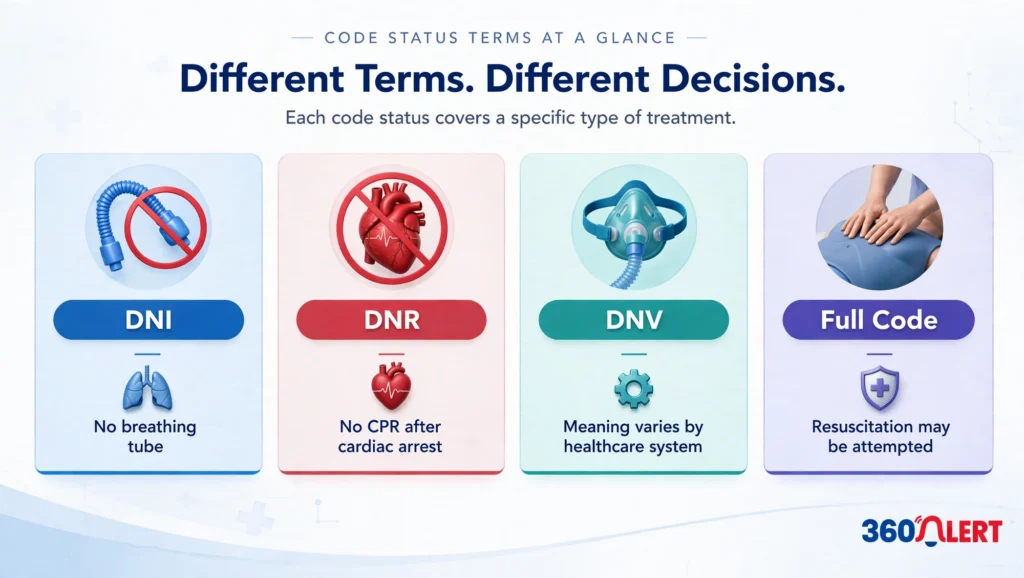
Comparing Code Status Terms: DNI vs DNR vs DNV vs Full Code
| Term | Meaning |
| Full Code | The medical team will usually provide CPR and other emergency life-support treatments unless a valid order says otherwise. Exact policies may differ between hospitals and locations. |
| DNR | Do Not Resuscitate: The patient does not want CPR or related resuscitation treatment if the heart stops. This does not automatically mean no oxygen, medicines, hospital care, surgery, or other treatment. |
| DNI | Do Not Intubate: The patient does not want an endotracheal breathing tube or invasive mechanical ventilation through that tube. Other treatments may still be provided. |
| DNV | Do Not Ventilate: Some healthcare systems use this term to mean something similar to DNI. The exact meaning can differ, so the specific medical order should be checked. |
| DNR/DNI | The patient does not want CPR or intubation. These are two separate decisions, even when they are recorded together. |
The distinction matters because cardiac arrest and respiratory failure are not the same event. A person may say no to CPR if their heart stops and the condition cannot be reversed. However, they may still agree to a short period of intubation if a treatable problem happens during surgery.
The opposite is also possible: someone may refuse intubation but still want CPR. Studies show that people’s choices can change depending on whether the medical problem is temporary and treatable. For this reason, doctors should discuss specific situations with patients and families instead of relying only on labels such as DNR or DNI.
Why are DNI and DNR often combined?
Patients often choose DNR and DNI together because both reflect the same goal, avoiding difficult, invasive treatment in advanced illness. Combining them also makes wishes easier to communicate quickly in an emergency. But CPR and intubation are still two separate decisions, even when they’re written down together.
A combined DNR/DNI label can sometimes hide these differences. For example, a patient may want treatment for pneumonia, oxygen, or BiPAP but not want a breathing tube. This does not mean the patient wants comfort care only.
One study found that DNR/DNI status affected doctors’ decisions about other treatments too. These included placing a central line, admitting the patient to the ICU, asking for a dialysis consultation, and requesting a surgical consultation.
For this reason, medical records should clearly state which treatments the patient wants or does not want and when those wishes apply.
What happens in an emergency?
When a patient arrives in the emergency department or becomes critically ill, clinicians check the medical record and available advance-care documents, then clarify the patient’s preferences with the patient or legally recognized surrogate. If a valid DNI order is confirmed, the team should avoid intubation while continuing treatments that the patient has accepted.
Things get harder when documentation is missing, unclear, or contradictory. In that case, doctors stabilize the patient first, then quickly work to confirm the person’s wishes and who can legally speak for them.
A general “DNR/DNI” label shouldn’t be treated as a reason to withhold unrelated treatment. Mixing up CPR decisions with ventilator decisions can lead to patients not getting care they actually wanted.
Reversible versus non-reversible respiratory failure
A DNI order can still apply when the breathing problem might get better. However, each patient may make different choices for different situations.
For example, someone might accept a breathing tube for a temporary blocked airway, but refuse one if the cause is an advanced, life-limiting illness. Research shows people with DNR/DNI orders are more willing to accept intubation when there’s a real chance the problem can be reversed.
Some patients with a DNI order may receive non-invasive ventilation, such as BiPAP, for sudden or worsening breathing problems. This treatment may be used to help the patient recover or simply to relieve discomfort. These goals are different, so they should be discussed clearly with the patient and family.
What if a DNI patient needs surgery?
A DNI order doesn’t automatically answer every question about surgery. Some operations need a temporary breathing tube, and the patient may accept it, refuse it, or agree to it only under certain conditions. Doctors treat this as part of a bigger conversation about anesthesia and ICU care, not as a blanket refusal of everything.
The patient, surgeon, anesthesiologist, and decision-maker should discuss whether the order is suspended, modified, or maintained during anesthesia and recovery, and what limits apply if complications occur. The discussion should address the procedure’s purpose, the expected duration of ventilation, the possibility of postoperative extubation, and what should happen if the patient cannot be liberated from the ventilator. These questions belong in the broader anesthesia and ICU discussion of life-sustaining treatment.
Why do people choose a DNI order?
Once the DNI meaning medical is clear, the next question is why someone would choose this order. Do not resuscitate and do not intubate orders are often discussed together in advance care planning conversations.
People may choose DNI because of:
- Advanced cancer or another life-limiting illness
- Severe chronic lung, heart, neurological, or neuromuscular disease
- Previous difficult experience with intensive care
- concerns about prolonged ventilation, loss of independence, or quality of life
- Personal, religious, or family values
- Preference for non-invasive or comfort-focused treatment if breathing worsens.
Decision aids and preference studies support discussing these choices in relation to expected outcomes, reversibility, and the patient’s values rather than presenting DNI as a hospice-only decision.
A DNI order is not limited to hospice. It can be relevant in an ICU, emergency department, or general hospital ward; studies of non-invasive ventilation included both ward and ICU patients. The important issue is whether the order reflects an informed and current decision.
How is a DNI order established?
A DNI form, such as a POLST or hospital order sheet, records this decision. The process varies by state, country, and healthcare system but commonly involves a conversation with a clinician and documentation in one or more of these forms:
- POLST or equivalent medical-order form: translates current treatment preferences into actionable medical orders, often for people with serious or advanced illness. POLST is distinct from an advance directive and is generally signed by a clinician after discussion with the patient or legally recognized surrogate.
- Advance directive: a legal document that can include a living will and/or appointment of a healthcare agent or durable power of attorney.
- Living will: records preferences about future life-sustaining treatment if the person later cannot speak for themselves.
- Healthcare proxy or medical power of attorney: names a person to make decisions when the patient lacks decision-making capacity.
- Hospital medical order: records the decision in the patient’s chart and electronic medical record.
A form alone is not a substitute for a clear conversation. POLST programs are designed to provide specific, portable instructions about treatments such as CPR, hospitalization, intensive care, and ventilatory support, but implementation and legal recognition differ by jurisdiction.
Can a DNI order be reversed?
A patient who can make their own medical decisions can usually change or cancel a DNI order at any time. They should tell their doctor or healthcare team directly.
The team should update the patient’s medical record, POLST form, advance directive, and any other related documents. If the patient cannot make decisions, an approved healthcare proxy or family decision-maker may help, depending on local law and the patient’s known wishes.
Because rules differ by location, the healthcare team should record the change officially. Do not rely only on a message passed through family members.
DNI in hospice versus a general hospital
DNI orders are common in hospice and palliative-care settings, but they are not hospice-only orders. They may be relevant whenever a person wants to avoid invasive ventilation while still receiving hospital treatment, antibiotics, oxygen, BiPAP, diuretics, bronchodilators, or other therapies.
The 2018 systematic review found non-invasive ventilation being used in both hospital wards and ICUs, with comparable hospital survival in those settings in the included studies.
Frequently asked questions
DNI is a medical abbreviation for Do Not Intubate. The DNI medical definition refers to an order that tells the care team not to place a breathing tube or use invasive mechanical ventilation.
DNI limits intubation. DNR limits CPR after cardiac arrest. They are separate decisions and may be ordered together or independently.
Yes. A patient may decline intubation but still request CPR or may choose the reverse. The chart should state each preference separately and explain the circumstances.
The patient and anesthesia team should discuss whether temporary intubation is acceptable for the procedure, whether the order remains active, and what happens if ventilation is needed after surgery.
Not always. “Do Not Ventilate” is sometimes used as an equivalent term, but wording and institutional definitions differ. The actual order should be reviewed.
The patient may participate and sign relevant documents when legally and clinically appropriate. A clinician commonly enters or signs the medical order; if the patient lacks capacity, a legally recognized surrogate may participate according to local law. POLST is generally a clinician-signed medical order created after consultation with the patient or surrogate.
A patient with capacity can usually revoke or change the decision. The clinical team should document the change and update all applicable forms and records.
Clinicians look for valid orders and advance-care documents and ask the patient, family, proxy, or prior care team. If the patient’s wishes are unclear, the team must rapidly clarify them while providing appropriate emergency care under local law and policy. A DNR/DNI label should not be assumed to mean that every invasive or intensive treatment is refused.
When combined as DNR/DNI, it means the patient refuses both CPR after cardiac arrest and a breathing tube if breathing fails. Even combined, these are distinct decisions requiring separate discussion with the care team.
References
1. Berger J, Zelman V, Muir H, et al. (2017) Clinical Ethics of the Do-Not-Resuscitate (DNR) Order and Other Advanced Directives in Anesthesia and ICU. General Anesthesiology. https://doi.org/10.15360/1813-9779-2017-2-61-74
2. Cammarota G, Simonte R, Robertis ED (2023) Treatment of patients with ‘do not intubate orders.’ Current Opinion in Anaesthesiology.
https://doi.org/10.1097/ACO.0000000000001238
3. Wilson ME, Majzoub A, Dobler C, et al (2018) Noninvasive Ventilation in Patients With Do-Not-Intubate and Comfort-Measures-Only Orders: A Systematic Review and Meta-Analysis*. Critical Care Medicine.
https://doi.org/10.1097/CCM.0000000000003082
4. Breu AC, Herzig S (2014) Differentiating DNI from DNR: combating code status conflation. Journal of Hospital Medicine.
https://doi.org/10.1002/jhm.2234
5. Beebe D (2001) Complications of tracheal intubation. Seminars in Anesthesia, Perioperative Medicine, and Pain. https://doi.org/10.1053/SANE.2001.25869
6. Wilson K, Aaron S, Vandemheen K, et al (2005) Evaluation of a decision aid for making choices about intubation and mechanical ventilation in chronic obstructive pulmonary disease. Patient Education and Counseling. https://doi.org/10.1016/J.PEC.2004.04.004
7. Jesus J, Allen MB, Michael GE, et al (2013) Preferences for resuscitation and intubation among patients with do-not-resuscitate/do-not-intubate orders. Mayo Clinic proceedings. https://doi.org/10.1016/j.mayocp.2013.04.010
8. Stream S, Nolan A, Kwon S, Constable C (2018) Factors Associated with Combined Do-Not-Resuscitate and Do-Not-Intubate Orders: A Retrospective Chart Review at an Urban Tertiary Care Center. Resuscitation. https://doi.org/10.1016/j.resuscitation.2018.06.020
9. Wilcox SR, Richards J, Stevenson E (2019) Association Between Do Not Resuscitate/Do Not Intubate Orders and Emergency Medicine Residents’ Decision Making. Journal of Emergency Medicine. https://doi.org/10.1016/j.jemermed.2019.09.033
10. Meier D, Beresford L (2009) POLST Offers Next Stage in Honoring Patient Preferences. Journal of Palliative Medicine. https://doi.org/10.1089/jpm.2009.9648
11. Vilaça M, Aragao I, Cardoso T, et al. (2016) The Role of Noninvasive Ventilation in Patients with “Do Not Intubate” Order in the Emergency Setting. PLoS ONE. https://doi.org/10.1371/journal.pone.0149649