
Hospitals are environments of high stress where situations can escalate rapidly. Code Gray is a behavioral emergency that needs an immediate response. What does Code Gray mean at the hospital? Code Gray in the U.S. is used to refer to an aggressive or violent person who may be unarmed, such as a patient, a visitor, or a staff member.
This code activates the clinical and security teams to deescalate situations safely, while protecting visitors, staff, or patients. From frontline nurses and administrators to healthcare managers, understanding code gray, protocol, and best practice is crucial for everyone involved in the industry. This comprehensive guide will cover definitions as well as triggers, steps-by-steps responses, comparisons with other codes, international variations and training.
Why Hospitals Use Colour Codes such as Code Gray
Hospital emergency codes provide a discrete way of communicating quickly without alarming patients and visitors. A single announcement can mobilize the right team immediately. The system evolved out of the need for standardization following tragic incidents when inconsistent codes caused harm and confusion. Organizations such the Hospital Association of Southern California HASC promoted uniform codes. For example, Code Gray was used for combative individuals while Code Silver was for armed threat.
These codes help to ensure the safety of both patients and staff, as well as efficient risk management. They are designed to reduce anxiety, establish clear roles, and facilitate quick action in violent situations. Even though not all standards are the same, they share a common core principle: to protect lives while causing minimal disruption.
Common Hospital Emergency Codes (U.S. Standardized Examples)
| Codes to help you code | What Does It Mean? | Typical Response Teams |
| Code Red | Fire or smoke | Firefighting and evacuation as needed |
| Code Blue | Adult cardiac/respiratory collapse | Medical emergency teams (METs) |
| Code White | Pediatric medical emergency | Pediatric specific responders |
| Code Gray | Combative or aggressive person (unarmed) | Security + clinical deescalation team |
| Code Silver | Active shooter / Person with a Weapon | Lockdown, security and law enforcement |
| Code Pink | Infant abduction | Secure exits |
| Code Purple | Child abduction | Security, broaden your search |
| Code Yellow | Threat or internal disaster | Security/incident command |
Note: Verify the exact meaning of each code at your facility. There are many variations.
Code Gray Hospital Definition: Meaning and definition
The code gray hospital is most commonly used to describe a situation in which a combative, or potentially violent person without a gun. The code gray hospital could refer to physical aggression or verbal threats. Throwing objects or attempting to harm others or yourself is also included. The goal is to restore security through deescalation, presence of security, and, as necessary, restraints or removal.
In some cases, it can also refer to a psychiatric crisis or severe agitation. The announcement typically includes a location and a description (e.g.
Code Gray:
- Code Silver: Unarmed Threat (usually Code Silver activates in the case of armed threats).
- An emergency mental state, which is usually accompanied by pain, delirium and substance abuse.
- Preventing harm to anyone is the main goal.
When is Code Gray used in a hospital setting?
Code Gray activates when the agitation escalates to violence or an imminent threat. Triggers that are common include:
- Intoxication, pain, or confusion can cause a patient to become aggressive or refuse treatment.
- An angry member of the family is a result of perceived delays and poor outcomes.
- Visitors displaying threatening behaviour in waiting areas or patient rooms.
- Instances of self-harming or violence against staff in psychiatric units.
- Rare cases of staff on staff or staff on patient aggression.
In reality, real-life scenarios involve patients who have dementia, acute psychosis and drug-induced agitation. Early identification of warning signs – raised voice or fists; pacing; or invasions of personal space – allows for proactive intervention prior to a full code being required.
Code Gray violence incidents in hospitals highlight how quickly things can escalate. In a documented case, the “Code Grey Crisis Prevention Team” was used by a psychiatric facility to calm agitated and aggressive patients using verbal methods and environment adjustments. This avoided restraints while reducing injuries.
Code Gray vs. Code White or Code Silver: The Differences
There’s a tendency for confusion between different codes of conduct, so clear distinctions are important.
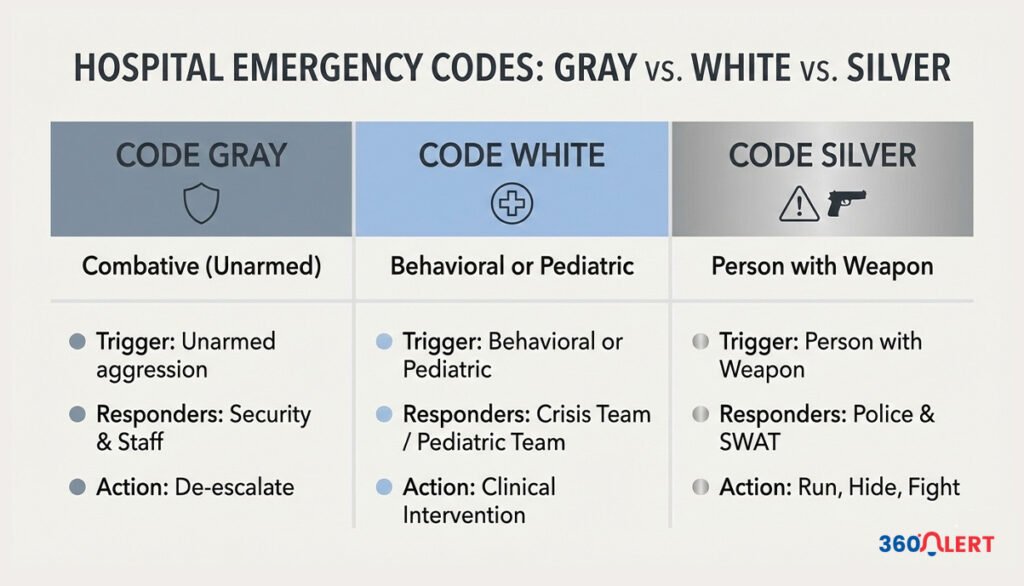
Code Gray Hospital vs Code White Hospital. In many U.S. Hospitals Code White signals a medical emergency for children. Code White can be used to denote a violent, behavioral, or other emergency in parts of Canada as well as some U.S. healthcare facilities. It is always best to confirm local information. Code Gray generally applies to adult or combative situations.
Code Gray vs Code Silver. The main difference between the two is the presence of weapons. Code Gray assumes weapons are not present and emphasizes deescalation by providing security support. Code Silver signals an active shooter (armed), hostage, or armed situation. This triggers a lockdown, shelter-inplace, and police involvement.
Comparison Table of Behavioral Emergency codes
| Aspect | Code Gray | Code White | Code Silver |
| Threat Level | Unarmed aggression | Violent/behavioral (varies) | Armed Person or Active Shooter |
| Primary Response | De-escalation and security + clinical | Security + clinical Team | Law enforcement + lockdown |
| Staff Actions | De-escalate the situation and protect it | Gray | Evacuate, hide, barricade |
| Announcement Examples | “Code Gray – 3 West agitated male.” | Varies depending on facility | Code Silver is a threat. |
| Typical Results | Resolve with minimum force | Resolve with minimum force | Potential police intervention |
By understanding these differences, you can avoid dangerous mistakes. For example, staff who rush towards a armed threat.
Code Gray Hospital Response Protocol and Steps
There is a standard code gray hospital procedure in all facilities, but there are some core steps that remain the same.
- Recognize, Assess and Ensure Safety — Identify aggressive behavior and take immediate action to ensure the safety of yourself and patients nearby.
- Activate Code — Call designated security lines or use emergency buttons. Provide the location, description, as well as nature of the danger.
- Announce – The operator’s page will read: “Code Gray… [location]… [description]. This alerts first responders to the situation without creating panic in the public.
- Secure the area — Remove non-essential individuals, protect vulnerable people (e.g. moving beds if you can), and maintain an appropriate distance.
- De-escalate. Staff are trained to use verbal strategies: listen with empathy, talk calmly, provide choices, define limits, and avoid conflict.
- If necessary, intervene. Security can provide presence. Clinical team may administer medications or apply restraints to the child as a very last resort.
- Document and Resolve — After the incident is resolved, resume normal operations. Document it thoroughly and provide support to staff.
- Debrief — Re-examine what worked and identify improvements. If needed, provide counseling.
Code Gray Hospital’s Response Steps (Actionable Checklist).
| Step | Key Actions | Parties to the Agreement |
| 1. Safety First | You and others should be removed from immediate danger | All Staff |
| 2. Activate | Call security; provide precise details | Witness/ Nurse |
| 3. Communicate | Use calm, clear language; announce code | Operator / Leadership |
| 4. De-escalate | Listening openly with an empathic attitude is a choice. | Clinical lead |
| 5. Support | Monitoring and providing backup medical care | Security + Nursing team |
| 6. Post-Incident | Document, debrief, review policy | All involved + Risk Management |
Personnel working in a hospital should adhere to the Code Gray procedure, which emphasizes safety.
The De-Escalation Methods and the Staff Responsibilities
De-escalation of code gray hospitals is best achieved through training, not force. Proven techniques include:
- Active listening and validating feelings (“I’m able to see that you’re really upset …”).
- Maintaining safe distances and non-threatening bodies language.
- Giving realistic choices can help restore control.
- Using a low, calm tone of voice.
- Avoiding arguments or sarcasm.
Roles and responsibilities for hospital code grey staff vary.
- Nurse Role — Assess the medical contributors (pain and delirium), initiate a code, tell responders about history, and advocate for minimally restrictive interventions.
- Doctor Role: Evaluate for any underlying conditions. If necessary, prescribe medication. Restraints can be authorized when clinically justified and legally.
- Security — Provide onsite presence, remove any individual, if required, and coordinate law enforcement.
- All Staff — Participate in drills and know the routes to evacuate, report incidents.
Code gray hospital safety and security response procedures prioritise prevention through early intervention (e.g., quiet room, panic buttons).
Code Gray Hospital Policies, Drills Training and Code Gray Policy
Code Gray training in hospitals is mandatory. It includes simulations, annual refresher classes, Crisis Prevention Institute or similar programs. Code gray drills at hospitals are designed to test teamwork, communication, and response time. Policies are developed to address issues such as risk assessment and the identification of high-risk individuals in patient records. They also include post-incident help, compliance with OSHA workplace safety standards, and support for victims.
A code grey hospital checklist may include the following:
- Panic buttons available
- Clear de-escalation scripts posted.
- Stocking of restraint kits and reviewing protocols
- Documentation training for staff to protect legal rights.
Code Gray Hospital Canada Australia:
Code Gray is used in all hospitals. No.
- Code Grey, which is sometimes used in Canada, may be used when there’s a system failure (power outage) or an external air exclusion.
- Code Grey in Australia (e.g. Victoria), specifically addresses workplace violence with response teams that emphasize clinical leadership and harm minimization.
- Some regions use plain-language safety alerts (“Security – Aggressive patient in ED”) to clarify.
When traveling or working in another country, it is important to review the policy of your hospital.
Legal Considerations on Risk Management, Patient Safety, and Other Related Issues
Legal considerations in code gray hospitals are the documentation of restraint, the rights of patients, and workplace safety laws that protect staff. Facilities must strike a balance between duty of care and least restrictive practices. In order to reduce future incidents, it is important that hospitals report all incidents.
Code grey patient safety is still paramount. Many agitated patients have unmet medical and emotional needs. Compassionate, trauma informed care is better for all.
The Benefits of Code Gray for Hospitals: Best Practices
Standardized codes are a great way to improve safety, promote rapid response times, and reduce injuries. Best practices include proactive assessment of risk, training that is ongoing, modifications to the environment, and a leadership commitment to zero tolerance towards violence.
Code Gray Systems: Their Pros and Cons
- Pros: Quick mobilization and clear roles. Reduced panic.
- Cons: If training is inconsistent, there’s a risk of overuse or subuse; the variations can be confusing.
Conclusions and Practical Takeaways
Code Gray, which focuses on the de-escalation of aggressive or violent situations, as well security support and protection for all those involved, is a valuable tool in managing these situations. Understanding the code grey hospital definition, mastering response procedures and recognising variations such as code gray hospital Canada or Australian protocols is vital to reducing trauma and saving lives.
What you need to know:
- Learn the codes and procedures for your specific facility.
- Prioritize personal security and de-escalation.
- Participate actively during training and drills.
- Documentation for legal and quality improvements.
- Everyone should be responsible for promoting a culture of violence prevention.
If you are a nurse, doctor or security officer, you can contribute to creating a safer environment for healthcare by staying informed. Comment below to share what you learned if, or if, you responded to a Code Gray. Subscribe to the newsletter for information on hospital security, emergency preparedness or staff wellness. You can also explore our guides on other codes, de-escalation techniques and related codes.
Your feedback helps us create even more valuable content. Stay safe and prepared.
Code Gray FAQ
What is code Gray at the Hospital?
It’s an emergency code that indicates a person who is combative or aggressive and needs security and clinical intervention for safety.
What is code gray?
A security response is usually directed at an unarmed person who is violent, aggressive, or threatens others.
What is the code gray in a medical facility?
When a person’s behavior escalates and becomes aggressive, violent, or violent, posing an immediate risk.
What to do in the event of a Code Gray?
Safety is paramount. Activate the code and provide details. Then, perform your assigned role. If you’re trained and are safe, de-escalate and support the entire team.
Code Gray is it the same at all hospitals?
Meanings can vary from country to country and facility to facility. In the U.S. this is usually a reference to combative persons.
What is code gray?
Code Gray signifies an unarmed situation; Code Silver means a weapon or active shooter.
What is the Code Grey Hospital policy for staff?
Follow facility specific protocols: activated, secure the area de-escalate document and debrief.
Code Gray/Hospital Emergency Codes from Top.gov Resources
- Pennsylvania Patient Safety Authority – Standardized Emergency Codes Advisoryhttps://patientsafety.pa.gov/ADVISORIES/Pages/201503_01.aspx – Discusses variations in codes across Pennsylvania hospitals. Code Gray is commonly used to mean “Combative individual” (unarmed and aggressive). Excellent for explaining confusion over codes, standardization initiatives, and why Code Gray is better than Code Silver for safety.
- Maryland Regulations – Uniform Emergency Codes (COMAR 10.07.01.33)https://regs.maryland.gov/us/md/exec/comar/10.07.01.33 – Official state regulation requiring hospitals to use uniform codes. Code Gray (which means “elopement”) is shown here. However, it also demonstrates how codes are mandated by the state and can vary.
- HHS/ASPR TRACIE – Code Grey (Active Violence) Exercise Templateshttps://files.asprtracie.hhs.gov/documents/aspr-tracie-ta-code-grey-exercise-templates-10-21-19.pdf – Federal HHS resource (Assistant Secretary for Preparedness and Response). Code Grey is covered for situations of active violence and abuse, along with templates for hospital drills. The training section, protocol and preparedness are all excellent.
- Minnesota Department of Health – Essentia Health Response Policy (example hosted on .gov)https://www.health.mn.gov/facilities/patientsafety/preventionofviolence/docs/essentiahealthresponsepolicy.pdf – State health dept. Code Gray document is used to activate when staff are feeling threatened/need help with control. This is a good example of a real policy for violent/aggressive circumstances.
- VA.gov – R&D Emergency Preparedness Plan (Portland VA)https://www.va.gov/PORTLANDRESEARCH/documents/erplan.pdf – Veterans Affairs example listing Code Grey for behavioral emergencies. Use of federal healthcare systems.
- NIH/PMC – Aggression, violence and threatening behaviour during critical illnesshttps://pmc.ncbi.nlm.nih.gov/articles/PMC10581280 – PubMed Central (NIH-hosted) article on Code Grey in Australian ICU (unarmed violence/aggression). Useful for international context as well as prevalence data.