
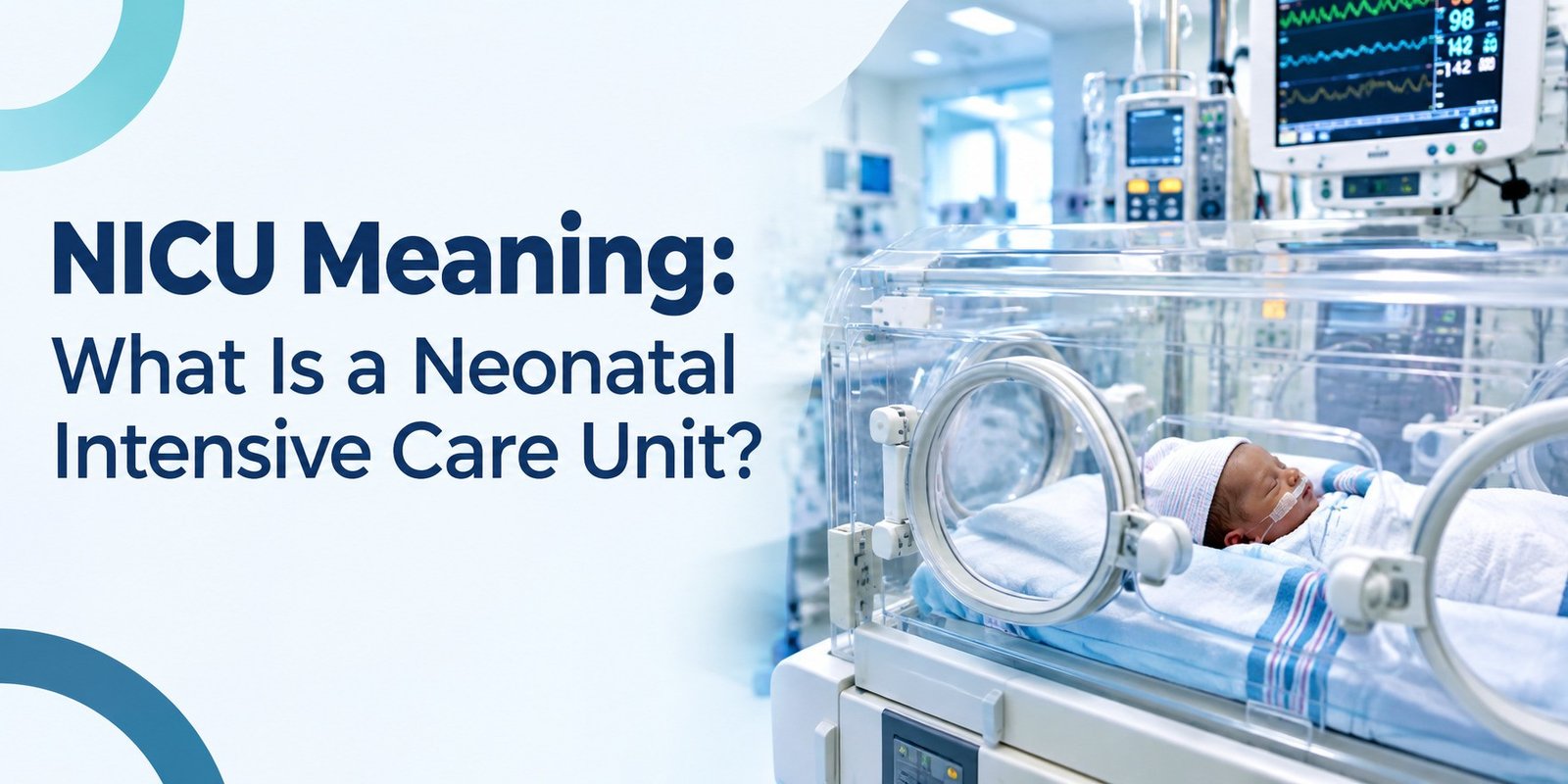
If your baby has just been admitted, or a doctor has said the word and you’re trying to work out what it means, here’s the short answer. The NICU meaning is straightforward: NICU stands for neonatal intensive care unit. It’s a hospital unit built for newborns who need closer monitoring or more treatment than a routine newborn nursery can provide, whether that’s help with breathing, feeding, warmth, an infection, or surgery.
That’s the NICU meaning in one line. The rest of this guide covers why babies are admitted, what the levels mean, who will be looking after your baby, and what happens before you go home.
Key takeaways
- NICU stands for neonatal intensive care unit. It’s said as “NICK-you”.
- It’s a hospital unit for newborns who need more support than a regular nursery can give.
- Babies go there mainly for prematurity, low birth weight, or a medical condition needing closer care.
- NICUs run from Level I to Level IV. The level describes what a unit is equipped to handle, not how sick your baby is.
- Parents aren’t visitors. Holding, feeding, and skin-to-skin contact are part of the care plan when it’s safe.
What Does NICU Stand For?
NICU stands for neonatal intensive care unit. Most people say the abbreviation as a word rather than spelling it out, pronounced “NICK-you”. Some hospitals call the same place a newborn intensive care unit or an intensive care nursery. The word neonatal simply refers to the newborn period, so a neonatal unit is a newborn unit.
What Is a NICU?
A useful NICU definition is a hospital department designed entirely around newborns. The equipment is smaller, the staff are trained specifically in newborn care, and someone is present around the clock. The technology matters, but the real difference from a regular nursery is how continuously a baby is watched.
Larger units are often divided into zones rather than being one open room. There’s usually a critical care area for babies needing constant monitoring and intervention, an intermediate area for babies who are stable but still need specialized care, and a step-down section for babies who are nearly ready to go home. Moving from one area to another is a sign of progress, so it helps to find out early how your hospital organizes this.
What a particular NICU can handle depends on its designated level, which is covered further down.
Why Do Babies Go to the NICU?

Infants in NICU care aren’t all unwell in the same way, and some aren’t unwell at all in the way parents imagine. Plenty are simply small, early, and in need of time. The reasons a NICU baby is admitted usually come down to one of three things.
- Prematurity. A baby born before 37 weeks may need help with breathing, feeding, gaining weight, or holding their temperature. In the US, roughly 1 in 10 babies are born preterm.
- Low birth weight. Under 5 pounds 8 ounces, or about 2,500 grams. Smaller babies lose heat quickly and can struggle to take in enough nutrition.
- A medical condition. Breathing trouble, infection, congenital heart disease, a birth defect, a neurological problem, or anything else needing a higher level of monitoring and treatment.
Multiples are admitted more often than single babies, largely because twins and triplets tend to arrive earlier and smaller.[4]
A NICU admission is not a verdict on how the pregnancy went or on anything a parent did. Many admissions are brief and precautionary, and some babies are there for observation rather than treatment.
What makes NICU care more likely before birth
If you are reading this because your baby is already in the NICU, you can skip this section. It is here for parents researching a high-risk pregnancy ahead of a delivery.
Care teams weigh the pregnancy, the delivery, and the baby together. None of these decides anything on its own, plenty of babies with several of them never need the NICU, and none of them is something a parent caused.[4]
| Category | Examples |
|---|---|
| Pregnancy factors | Diabetes, high blood pressure, bleeding, infection, too little or too much amniotic fluid, carrying multiples, premature rupture of membranes |
| Delivery factors | Fetal distress or lack of oxygen, breech or another unusual position, meconium passed before birth, cord around the neck, forceps, vacuum, or cesarean delivery |
| Baby factors | Born before 37 or after 42 weeks, birth weight under 2,500 g or over 4,000 g, small for gestational age, resuscitation in the delivery room, birth defects, respiratory distress, infection, seizures, or low blood sugar |
NICU Levels Explained
Something most parents only learn on arrival is that not every NICU offers the same care. The difference matters enough that the American Academy of Pediatrics sets formal standards for it.[1] Levels describe what a unit is staffed and equipped to handle. A Level II nursery isn’t a worse hospital than a Level IV one; it’s a different scope.
| Level | Common name | What it’s equipped for |
|---|---|---|
| Level I | Well newborn nursery | Healthy newborns, and babies born at 35 weeks or later who stay stable. Can resuscitate at delivery and stabilize a sicker or earlier baby until transfer. |
| Level II | Special care nursery | Babies born at 32 weeks or later weighing at least 1,500 g (3 lb 4.9 oz) who are moderately unwell with problems expected to resolve quickly. Can give CPAP and short-term mechanical ventilation, usually under 24 hours. Also cares for babies recovering from intensive care. |
| Level III | Neonatal intensive care unit | Babies born before 32 weeks or under 1,500 g, and critically ill babies at any gestation. Sustained life support, the full range of respiratory support, advanced imaging, and access to pediatric surgeons and subspecialists. |
| Level IV | Regional NICU | Everything a Level III does, plus on-site surgical repair of complex congenital conditions and a full range of pediatric surgical subspecialists and anesthesiologists available continuously. |
Those gestational ages and weights are thresholds for planning, not hard cut-offs. A hospital assesses each baby individually, and units vary in what they offer within the same level.
What is a Level 3 NICU?
A Level 3 NICU is a full intensive care setting for newborns, and it’s the level most people mean when they say NICU without qualifying it. Beyond what the table above covers, a Level III unit can run CT, MRI, and echocardiography urgently, and can deliver high-frequency ventilation and inhaled nitric oxide when conventional support isn’t enough.[2] Most mid-sized and large hospitals with a maternity service have one.
Who decides which NICU your baby goes to?
The medical team decides what level of care your baby needs. The hospital itself is often your choice, particularly if a need is identified before birth. If you know in advance that NICU care is likely, ask to meet the neonatology team and tour the unit beforehand. Neonatologists generally welcome this, and walking in having already seen the room makes an enormous difference on the day.
If a baby needs a level of care the delivering hospital can’t provide, they’re moved in a transport incubator, which carries its own ventilator, monitors, and oxygen supply. Babies who need intensive care tend to do better when they’re born at a hospital with a NICU rather than transferred after birth, which is one reason high-risk pregnancies are often delivered at larger centers.
Conditions Treated in the NICU
What happens next depends on your baby’s diagnosis, gestational age, size, and how stable they are. Common reasons for NICU care include:
- Respiratory conditions: Respiratory distress syndrome from underdeveloped lungs, transient tachypnea of the newborn, apnoea, and breathing trouble following a difficult delivery.
- Jaundice: Yellowing of your baby’s skin and eyes from high bilirubin. Nathan Gollehon, MD, a neonatologist at Nebraska Medicine, explains that the yellow color itself matters far less than the bilirubin level behind it, since a very high level can cause lasting injury to the brain. Phototherapy lights help break the bilirubin down, and this is one of the most common reasons babies are admitted.
- Infection and newborn sepsis: Bacterial, viral, or fungal infection, confirmed or suspected, treated with antibiotics and close monitoring.
- Low blood sugar: Hypoglycemia needs frequent checks and glucose support, particularly in premature babies and those whose mothers had diabetes. Dr. Gollehon describes untreated low blood sugar as making babies jittery and reluctant to feed, with seizures possible if it is severe and goes unnoticed, which is why it is monitored so closely.
- Congenital heart disease: Heart conditions present at birth, which may need medication, imaging, catheter-based treatment, or surgery.
- Birth defects: Including cleft lip and palate, neural tube defects such as spina bifida, and gastrointestinal conditions that may need early surgery.
- Neurological conditions: Seizures, brain malformations, hydrocephalus, or stroke.
- Necrotizing enterocolitis (NEC): A serious intestinal condition managed with close monitoring and specialist treatment.
- Feeding problems: Difficulty coordinating sucking, swallowing, and breathing, or not taking in enough to grow safely.
- Anemia, temperature instability, and vitamin K deficiency: Each monitored and treated as needed.
Neonatal abstinence syndrome is a newborn withdrawal condition that may require monitoring and supportive care; your baby’s clinicians will explain the specific plan.
Newborn metabolic screening is a routine heel-prick screening program carried out according to local public health policy. It isn’t a NICU admission and doesn’t mean a baby is unwell.
Who Cares for Your Baby in the NICU?
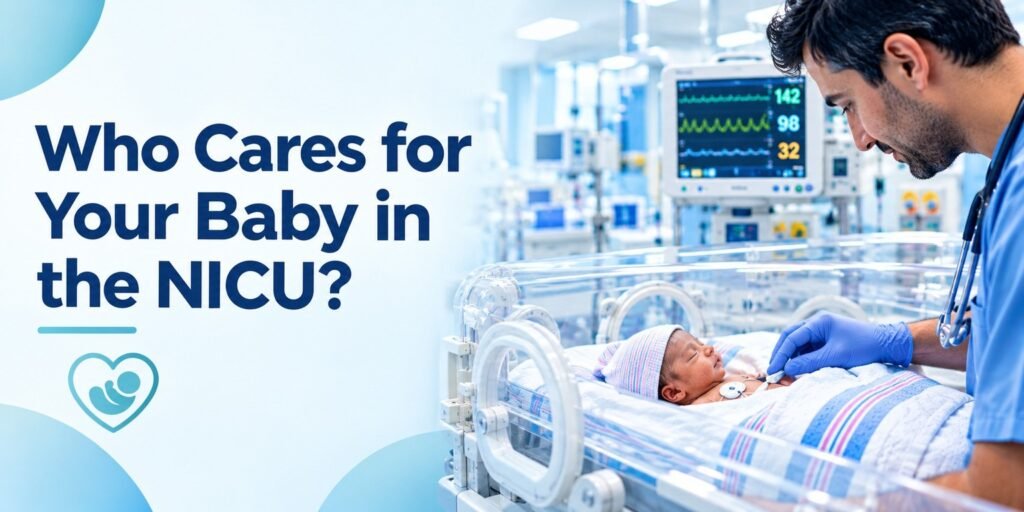
NICU care is delivered by a team rather than a single doctor, and you’ll meet most of these people during a longer stay.
- Neonatologist: A pediatrician with additional training in premature and seriously ill newborns, who leads medical decisions.
- Neonatal nurse practitioner: An advanced-practice clinician who assesses babies, performs procedures, and directs care alongside the neonatologist.
- NICU nurse (registered nurse): A NICU nurse provides bedside care around the clock, notices changes first, and teaches you how to care for your baby. In most units one is assigned to your baby specifically, and they become your main point of contact through the whole stay.
- Respiratory therapist: Manages oxygen, CPAP, ventilators, and other breathing support.
- Physical, occupational, and speech therapists: Support movement, development, positioning, oral-motor skills, and safe feeding.
- Registered dietitian nutritionist: Plans nutrition and tracks calories, protein, vitamins, and minerals for growth.
- Lactation consultant: Helps with milk supply, pumping, breastfeeding, and the transition to feeding at the breast or bottle.
- Pharmacist: Checks doses and medication levels, and explains medicines you’ll be managing at home.
- Social worker: Helps with emotional support, practical problems such as transport or money, and discharge planning.
- Hospital chaplain: Available for spiritual support and counselling if that’s something your family wants.
Ask who your baby’s primary contact is on each shift, and don’t hesitate to ask the same question twice. Clear communication with the team is consistently linked to lower parental stress.
NICU Equipment
The equipment is the part that unsettles most parents on day one. Each piece has a narrow, specific job, and the nurses are used to explaining all of it.
An incubator, sometimes called an isolette, is essentially an enclosed bassinet with climate control. It holds warmth in, keeps humidity steady, limits exposure to germs and noise, and has ports in the sides so lines and wires can reach your baby without the lid coming off. A radiant warmer does a similar job in an open bed.
Monitors track your baby’s heart rate, breathing, oxygen saturation, blood pressure, and temperature. IV lines and pumps deliver fluids, nutrition, medicines, or blood. Feeding tubes provide nutrition when a baby can’t yet feed safely by mouth. Breathing support ranges from a nasal cannula to CPAP to a mechanical ventilator, depending on how much help the lungs need. Phototherapy lights treat jaundice.
Alarms go off constantly in a NICU, and most of them mean very little. A sensor slips, a baby wriggles, a lead comes loose. The nurses can tell the difference at a glance, which is a large part of why they’re there.
NICU vs PICU vs ICU
These three units get mixed up constantly, and the distinction is simpler than it sounds.
| Unit | Who it’s for | Notes |
|---|---|---|
| NICU | Newborns | Neonatal intensive care, built specifically around babies in their first weeks. |
| PICU | Children from the newborn period through the teenage years | Pediatric intensive care. Broader age range and different expertise. |
| ICU | Usually critically ill adults | Some hospitals without a dedicated PICU use the ICU for older children. |
What separates them is the patient population and the expertise built around it, rather than how serious the illness is.
When a baby moves from the NICU to the PICU
A move to the PICU isn’t a step backwards. It usually happens because your baby has outgrown newborn-specific intensive care but still needs ongoing support, which can include a breathing tube, a tracheostomy, or a feeding tube. Some types of care are available in a PICU that a particular NICU doesn’t offer. These decisions vary by hospital and by the individual baby.
Being a Parent in the NICU
Parents aren’t visitors in a modern NICU. When the team says it’s safe, you can hold, feed, change, comfort, talk to, and read to your baby, and most units actively want you to. Cleveland Clinic notes that research links this kind of involvement to babies improving faster, shorter NICU stays, and better long-term outcomes.
Kangaroo care
Kangaroo care, or skin-to-skin care, means placing your baby in just a diaper against your bare chest with a blanket over both of you. March of Dimes describes the potential benefits: steadier warmth, more regular heart rate and breathing, better sleep, improved weight gain, support for breastfeeding, and lower stress for parents.[3] The team will tell you when your baby is ready and how long a session should last, since very small or very unwell babies can find handling tiring.
Taking care of yourself
Having a baby in intensive care is genuinely hard, and postpartum depression and anxiety are common and treatable. Some hospitals run dedicated behavioral health programs for NICU parents, and many offer mental health screening on the unit.
Practical support exists too. Ask the social worker about parent support groups, peer networks, accommodation near the hospital, and organizations such as Ronald McDonald House that provide places for families to stay. Asking for help early is easier than asking for it after weeks of running on nothing.
You’ll also notice NICUs are secure units with controlled access and identification checks. That’s standard newborn security practice, and it’s related to the code pink alert hospitals use for infant safety. It can feel clinical at first, but it exists to protect your baby.
How Long Do Babies Stay in the NICU?

There’s no standard length of stay, and any number you’re given early on is an estimate rather than a plan. Some babies go home within a few days. Others stay for weeks or months. Any estimate you are given in the first week is a best guess, and it is normal for it to change.
Length depends on why your baby was admitted and how they progress, and gestational age at birth is usually the biggest single factor. Dr. Gollehon notes that babies born just under the 37-week mark generally do well with short stays, while units now care for babies from as early as 22 weeks, whose needs are far more complex. In those cases, he says, “sometimes we have families in the unit with us for months” before a baby is strong enough to go home.
Discharge is decided by readiness, not by a date or a birth weight.
Going Home from the NICU
Before your baby is discharged, the team generally wants to see that they can feed safely, hold their own body temperature, breathe adequately, and grow steadily or follow a clear nutrition plan.
The transition usually involves more than handing you a bag. Depending on the hospital, it may include rooming in overnight while staff stay nearby, feeding practice, infant CPR or discharge classes, medication teaching, car seat preparation, and training on any equipment going home with you, such as oxygen, a feeding tube, or a monitor. March of Dimes recommends going through supplies, medicines, equipment, follow-up appointments, and who to call with questions before you leave.[4]
Most babies need a pediatrician visit within days of discharge. Many also need a neonatal follow-up clinic, specialist appointments, developmental monitoring, or feeding and therapy services. Dr. Gollehon describes follow-up clinics as serving two purposes: reassuring families whose babies are doing well, and connecting babies who are struggling to therapies quickly, since early intervention tends to improve outcomes. Ask for the discharge summary in writing, including what was treated and what follow-up is arranged.
A Note for Parents
Very few people expect to end up in a NICU, and finding yourself there is disorientating in a way that’s hard to prepare for. The machines are loud, the language is unfamiliar, and you may be recovering from birth yourself while trying to take in a great deal of information.
Two things tend to help. The first is asking questions repeatedly until the answers make sense, because nobody absorbs much in the first few days and the staff know it. The second is taking whatever part of your baby’s care you’re offered, however small it seems. Changing a diaper through the ports of an incubator doesn’t feel like much. To your baby, and to you, it turns out to be a great deal.
Frequently Asked Questions
A NICU treats newborns. An ICU is a general critical care unit that mostly treats adults, and it isn’t equipped or staffed for newborn care. Some hospitals without a dedicated pediatric ICU use their ICU for older children, but babies go to a NICU.
Most admissions come down to three things: being born early, being born small, or having a medical condition that needs closer monitoring. Prematurity is the most common reason on its own. Some babies are admitted for observation rather than treatment and go home within a few days.
The NICU cares for newborns. The PICU cares for children from the newborn period through adolescence. A baby may transfer from one to the other depending on their age, their needs, and how the hospital is organized.
There isn’t a standard three-stage system, which is why this question causes so much confusion. In the US, the American Academy of Pediatrics defines four levels of newborn care, from Level I for healthy newborns up to Level IV for the most complex cases.[1] What people often mean by stages is how a single unit is laid out inside: many NICUs have a critical care area, an intermediate area, and a step-down section, and a baby moving between them is a sign of progress. A Level II unit is often called a special care nursery, and some hospitals count it as a NICU while others don’t. Some countries outside the US do use a three-tier system, which adds to the confusion.
Anywhere from a few days to several months. Gestational age at birth is usually the biggest factor. Discharge depends on readiness rather than on a date or a target weight, so the team is looking for safe feeding, steady body temperature, adequate breathing, and reliable growth.
It’s usually said as a single word, “NICK-you”, rather than spelled out letter by letter.
In medical terms, a NICU is a unit staffed and equipped to give continuous intensive care to newborns, including sustained respiratory support, close monitoring, and treatment for prematurity, low birth weight, infection, birth defects, and other conditions.
Often yes, though it may start with pumping rather than feeding at the breast, particularly if your baby is very early or not yet coordinating sucking and swallowing. Most units have a lactation consultant who helps with establishing and protecting your milk supply in the meantime, and skin-to-skin contact supports breastfeeding once your baby is ready for it.
Usually yes, and most units encourage it. Overnight arrangements, sibling visits, and infection-control rules vary by hospital, so check your unit’s specific policy.
Not necessarily. Many admissions are short and precautionary, and prematurity alone accounts for a large share of them. Your baby’s team can tell you the specific reason for the admission.
References
1. Stark AR, Pursley DM, Papile LA, et al. Standards for Levels of Neonatal Care: II, III, and IV. Pediatrics. 2023;151(6):e2023061957. https://publications.aap.org/pediatrics/article/151/6/e2023061957/191305/Standards-for-Levels-of-Neonatal-Care-II-III-and
2. Barfield WD, Papile L, Baley JE, et al. Levels of Neonatal Care. American Academy of Pediatrics Committee on Fetus and Newborn. Pediatrics. 2012;130(3):587-597. https://pubmed.ncbi.nlm.nih.gov/22926177/
3. Touching and holding your baby in the NICU. March of Dimes. https://www.marchofdimes.org/find-support/topics/neonatal-intensive-care-unit-nicu/touching-and-holding-your-baby-nicu
4. Getting ready to go home from the NICU. March of Dimes. https://www.marchofdimes.org/find-support/topics/neonatal-intensive-care-unit-nicu/getting-ready-to-go-home-nicu
This article explains what a NICU is for general information. It isn’t medical advice and doesn’t replace what your baby’s care team tells you. If anything about your baby’s condition or care plan is unclear, ask the neonatologist or your baby’s nurse.