

Medical note: NPO instructions depend on the procedure, anesthesia or sedation plan, medical conditions, and local policy. If your surgical or hospital team gave you instructions that differ from this article, follow their instructions and ask before eating, drinking, or taking medication.
What does NPO mean?
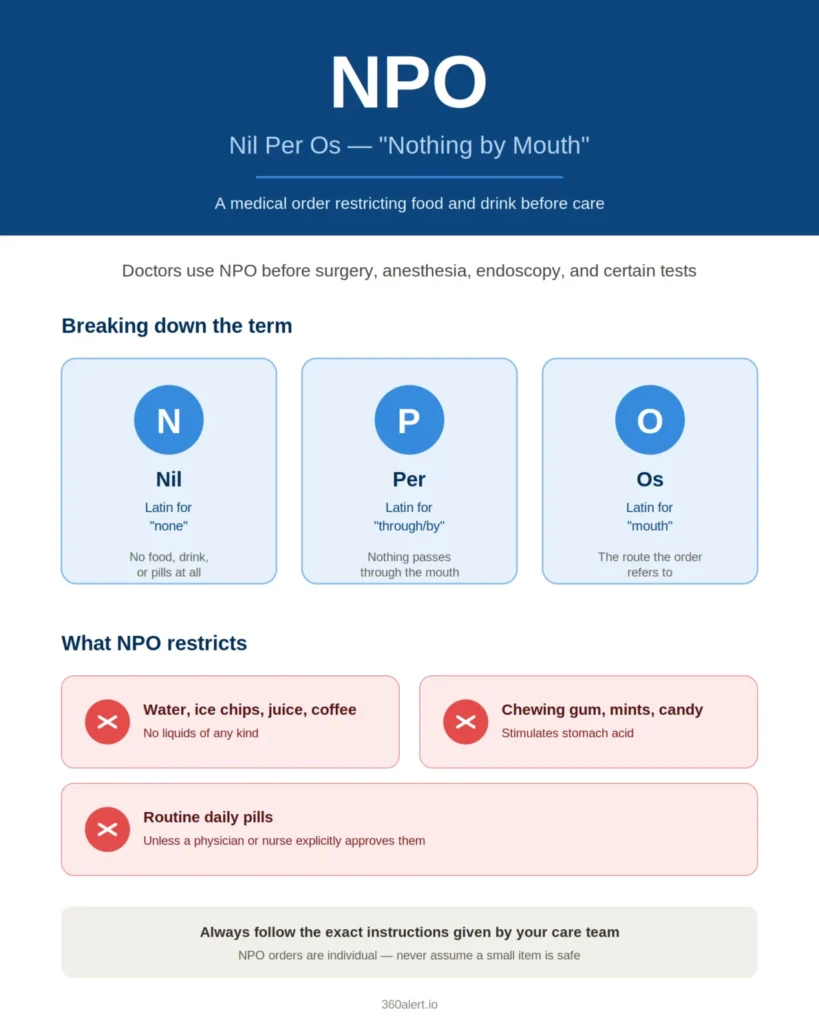
NPO is a medical abbreviation for the Latin phrase nil per os, meaning “nothing by mouth.” If a chart says you are NPO, your care team is limiting what you may swallow, sometimes all food and liquids, and sometimes only certain items for a defined period. The NCI Dictionary defines NPO as “nothing by mouth.”
NPO is not one universal diet. In a hospital, “NPO” may mean strict nothing by mouth, while a pre-procedure fasting instruction may still allow specified clear liquids until a specified cutoff. The exact order matters.
How do you pronounce nil per os?
NPO is commonly read as “N-P-O.” The Latin phrase is pronounced approximately “nil per oss.”
- nil = nothing
- per = through or by
- os = mouth
That is why “NPO status,” “NPO diet,” “NPO nursing,” and “nothing by mouth” all refer to a restriction on oral intake. It does not necessarily mean that a person cannot receive fluids or medicines by another route, such as an IV, injection, or feeding tube, but the route and safety decision must come from the clinical team.
Why do doctors order NPO?

1. To reduce aspiration risk during anesthesia or sedation
General anesthesia and deeper sedation can weaken the gag, cough, and swallowing reflexes that normally protect the airway. If stomach contents come back up and enter the lungs, the result can be pulmonary aspiration and, in serious cases, aspiration pneumonia.
Fasting aims to reduce the amount and acidity of stomach contents before anesthesia; it does not make aspiration impossible. Emergency surgery, certain medical conditions, delayed stomach emptying, and the type of procedure can change the risk calculation.
The concern applies most directly to general anesthesia and some forms of procedural sedation. Regional or local anesthesia may require different instructions, but sedation can still affect airway protection. Your anesthesia team decides which fasting rule applies.
2. To improve the safety and quality of a procedure
Endoscopy and colonoscopy instructions often combine fasting with procedure-specific preparation. An empty or relatively empty stomach may help the endoscopy team work safely, while bowel preparation clears the colon for a colonoscopy. The American Society for Gastrointestinal Endoscopy publishes guidance on sedation and anesthesia in gastrointestinal endoscopy, but the endoscopy unit’s written instructions should take priority for your appointment.
Some imaging or procedures may also require an empty stomach, especially when sedation, contrast, or an intervention is planned. Do not assume that instructions for one test apply to another.
3. To rest the digestive tract
NPO orders are also used when eating or drinking could worsen a gastrointestinal problem or interfere with treatment, for example, during suspected bowel obstruction, after certain operations, or when bowel rest is part of the plan. In the ICU, a patient may be temporarily NPO while clinicians assess whether oral or tube feeding is safe.
NPO for bowel rest is not the same clinical situation as preoperative fasting. The order may last longer and may include a plan for IV fluids, electrolyte replacement, decompression with a nasogastric tube, or nutrition through another route.
How long should you fast before a procedure?
The table below describes commonly used elective anesthesia intervals, not a personal instruction. The American College of Surgeons tells patients not to eat at least six hours before a procedure, notes that the period may be up to eight hours depending on age and medication, and advises stopping clear liquids two hours before the procedure. Pediatric guidance commonly distinguishes clear liquids, breast milk, infant formula, and solids because they leave the stomach at different rates.
| Intake | Common minimum fasting interval before anesthesia | What this means |
|---|---|---|
| Clear liquids | 2 hours | Water, pulp-free clear juice, and similar permitted liquids may be allowed until the team’s cutoff. Some hospitals use a shorter or more liberal policy for selected patients. |
| Breast milk | 4 hours | Applies to infants when the anesthesia team gives this instruction. |
| Infant formula | 6 hours | Formula generally empties more slowly than breast milk. |
| Light meal or nonhuman milk | 6 hours or more | A light meal is different from a heavy or fatty meal. |
| Solid food | 6–8 hours or more | The timing depends on the amount and composition of the meal and the procedure. |
| Heavy or fatty meal | Often longer than 6 hours | Ask the anesthesia team rather than using the light-meal interval. |
| Non-clear liquids | Follow the team’s specific cutoff. | Milk, cream, smoothies, and drinks with pulp are not automatically treated like clear liquids. |
These intervals are not interchangeable. If your procedure time changes, call the facility rather than calculating a new cutoff yourself. People with diabetes, reflux, delayed gastric emptying, bowel disease, pregnancy, obesity, or other conditions may need individualized instructions.
What can and cannot you have while NPO?

Strict NPO
Strict NPO generally means no food, drinks, ice, gum, mints, hard candy, or anything else by mouth unless a clinician explicitly permits it. Mouth care may still be allowed, but do not swallow the water used to rinse. A nurse can explain what “strict” means in your unit.
Pre-procedure fasting
Pre-procedure fasting may allow selected clear liquids until a defined time. Clear liquids are usually transparent and do not contain milk, cream, pulp, or solid pieces. Examples may include water and certain pulp-free clear juices. Coffee or tea with milk or cream is not a clear liquid; even black coffee or tea should be allowed only if the anesthesia team’s instructions say so.
Ice chips
Ice chips count as oral intake. Some inpatient teams allow them for comfort; others do not. Do not assume that ice chips are permitted because they melt into water.
Gum, mints, and hard candy
The ASA’s 2023 modular update specifically addressed chewing gum and carbohydrate-containing clear liquids, showing that these questions require more nuance than the old “nothing after midnight” rule. Gum may increase swallowing and gastric secretions, and policies differ on whether it changes the planned procedure. Tell the team if you chewed gum, used a mint, or sucked on a hard candy; do not hide it or guess whether the procedure can proceed.
Can you drink water while NPO?
Sometimes, but not always. If the order is strict NPO, water is not allowed unless the care team changes the order. If the instruction is preoperative fasting, small amounts of water may be allowed until a specified cutoff. The ACS describes stopping clear liquids two hours before a procedure but also tells patients that their healthcare team may require an earlier cutoff.
The safest question is, “Am I strict NPO, and if not, exactly what may I drink and until what time?”
NPO vs. fasting vs. clear-liquid diet
| Term | Typical meaning | Is anything by mouth allowed? |
|---|---|---|
| Strict NPO | Nothing by mouth for a clinical reason | Usually no, unless the order is changed. |
| General preoperative fasting | A time-limited restriction before anesthesia or sedation | Often specified clear liquids are allowed until a cutoff. |
| Clear-liquid diet | A permitted diet of transparent liquids without milk, cream, pulp, or solid pieces | Yes, within the prescribed plan |
| Full-liquid diet | Liquids and foods that are liquid at room temperature, often including milk-based items | Yes, if ordered, it is not the same as clear liquids. |
| Diet as tolerated | Advance food and drink according to symptoms and the care plan. | Usually yes, but follow the stepwise plan. |
A hospital chart may use “NPO status” even when the patient’s pre-procedure instructions are more specific. Read the full order or ask the nurse.
Can you take medication while NPO?
Do not stop prescription medicine on your own. Some routine medicines are taken with a small sip of water, while others are held, adjusted, or replaced with an IV or injected form. The ACS notes that routine medicines are usually taken with a sip of water on the morning of surgery, but diabetes medicines may need to be changed because the patient is not eating.
Tell the team about every prescription, over-the-counter medicine, vitamin, supplement, and herbal product. Pay particular attention to:
- insulin and other glucose-lowering medicines;
- blood thinners and antiplatelet medicines;
- blood-pressure medicines;
- medicines that affect stomach emptying;
- seizure medicines, steroids, and medicines that must be taken on schedule.
If you are already in the hospital and become NPO, the prescribing team may change the route or timing of medicines. “NPO” does not mean “skip every medication”; it means the oral route requires an explicit decision.
NPO guidelines for babies and children
Children and infants can become distressed, dehydrated, or hypoglycemic during prolonged fasting, so the goal is to use the shortest safe interval rather than an automatic overnight fast.
| Food or drink | Common interval used before anesthesia | Parent guidance |
|---|---|---|
| Clear liquids | 2 hours in many traditional guidelines | Use only the liquids and cutoff provided by the pediatric anesthesia team. |
| Breast milk | 4 hours | Confirm the interval for your infant’s age and procedure. |
| Infant formula | 6 hours | Formula and breast milk are not treated as identical. |
| Solid food | 6–8 hours or longer | A fatty or heavy meal may require more time. |
Professional guidance is changing in some settings. The pediatric literature describes institutions that permit clear liquids closer to the procedure, but policies vary; use your hospital’s instruction rather than a generic internet schedule.
If your child accidentally eats or drinks, write down what it was and when, then tell the surgical or anesthesia team. Do not delay reporting it because you are worried the procedure will be canceled.
NPO and diabetes
Fasting requires extra planning for people with diabetes because not eating changes the balance between glucose-lowering treatment and available carbohydrates. Perioperative diabetes guidance emphasizes medication adjustment, avoidance of unintended hypoglycemia or hyperglycemia, and close glucose monitoring; it also cautions against unnecessarily prolonged fasting.
Before the procedure
Ask the diabetes clinician, surgeon, or anesthesia team in advance what to do with insulin, sulfonylureas, other glucose-lowering medicines, and newer medicines that may affect stomach emptying. Do not improvise a dose reduction or omission.
During the NPO period
The team may check blood glucose repeatedly and use IV fluids, insulin, or other treatment when needed. The plan depends on diabetes type, current glucose, kidney function, procedure length, and the medication regimen.
If your blood sugar drops
Tell staff immediately if you feel shaky, sweaty, confused, weak, unusually sleepy, or otherwise unwell. Do not treat suspected hypoglycemia with food or drink unless the team tells you to; a patient who is NPO may need an alternative route such as IV dextrose. The team must also watch for high glucose and, in some patients, ketones or metabolic decompensation.
Why “NPO after midnight” is changing
“Nothing after midnight” is easy to communicate, but it can create a much longer fast when a procedure is scheduled late in the day. Modern perioperative pathways, including Enhanced Recovery After Surgery (ERAS), aim to avoid unnecessary fasting and support earlier recovery when it is safe. ERAS pathways include early postoperative drinking and mobilization as part of recovery.
Evidence from a large quality-improvement study found that a policy allowing clear fluids until arrival at the operating room shortened fasting duration and reduced reported thirst; the study did not establish that every patient can safely drink until arrival, and a small increase in regurgitation could not be ruled out.
The practical change is individualized timing, not permission to ignore NPO instructions. Your procedure, anesthesia type, comorbidities, and local protocol determine the safe window.
NPO beyond surgery: ICU, ED, and bowel rest
ICU
An ICU patient may be NPO before a procedure, while mechanically ventilated, after aspiration risk is identified, or while clinicians decide whether oral or enteral feeding is safe. A feeding tube does not automatically cancel an NPO order. A nasogastric tube, gastrostomy tube, or jejunostomy tube may be clamped, drained, used for medications, or used for nutrition according to a separate order.
Emergency Department
Emergency clinicians may temporarily keep a patient NPO “just in case” an operation, sedation, or urgent procedure becomes necessary. That does not prove that surgery will happen; it preserves options while the evaluation continues. Ask whether you may drink and whether the answer changes after imaging or consultation.
Bowel rest
NPO may be paired with IV hydration, electrolyte treatment, stomach decompression, or a planned nutrition strategy when the digestive tract needs rest. The duration can be longer than preoperative fasting and should not be ended without the treating team’s direction.
What happens if you break NPO?
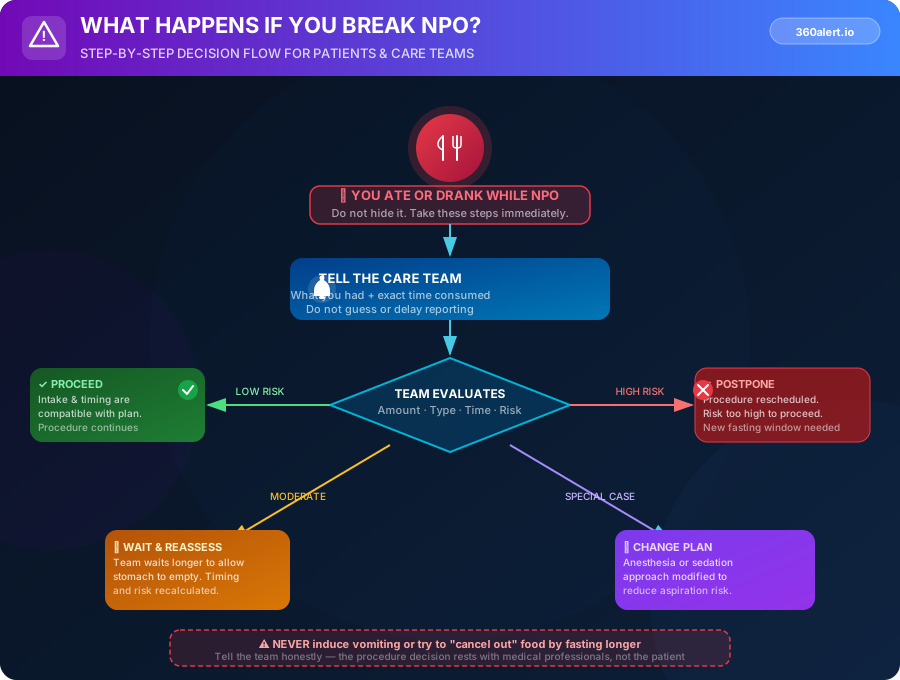
Tell the nurse, surgeon, endoscopy team, or anesthesia provider exactly what you had and when. The team may:
- proceed if the intake and timing are compatible with the planned procedure;
- wait longer and reassess;
- change the sedation or anesthesia plan;
- postpone or reschedule the procedure.
The decision depends on the amount and type of intake, time since consumption, the procedure, urgency, medical conditions, and aspiration risk. Do not induce vomiting or attempt to “cancel out” food or drink by fasting longer.
Emergency surgery: when there is no time to fast
Emergency surgery cannot always wait for a full fasting interval. In that situation, the anesthesia team treats the patient as having a potentially full stomach and uses risk-reduction measures appropriate to the case. These may include airway-protection strategies, rapid-sequence induction, suction readiness, and selecting an anesthetic plan based on urgency and patient risk.
Fasting is one risk-control measure, not a prerequisite that makes emergency care impossible. Tell clinicians when you last ate or drank, even if the answer is “very recently.”
When can you eat and drink again after being NPO?
The answer depends on why you were NPO and whether you had anesthesia, sedation, bowel surgery, vomiting, swallowing problems, or an ongoing aspiration risk. A common recovery sequence is
- The team confirms that you are awake enough to protect your airway
- You begin with permitted sips or ice chips;
- You progress to clear liquids if tolerated
- You try a light diet when the team approves it
- You return to a normal diet as tolerated and as medically appropriate.
After surgery, the IV may remain until you can drink adequately; ACS notes that an IV is often removed after the operation once drinking begins. If you have nausea, coughing with drinks, abdominal distension, severe pain, or repeated vomiting, stop and tell the care team.
The nursing care side of NPO
Nursing care during NPO status is more than withholding meals. The team may provide mouth care to reduce dryness, monitor hydration and urine output, maintain IV fluids when ordered, check blood glucose, and offer medication through a safe alternative route. Nurses also verify what the order means, communicate accidental intake, and coordinate the timing of procedures and diet advancement.
Patients can help by asking whether the order is strict NPO or time-limited fasting, keeping a written list of medicines, reporting thirst or symptoms, and telling staff promptly about anything swallowed.
Frequently asked questions
NPO stands for nil per os, a Latin phrase meaning “nothing by mouth.”
Do not assume smoking or vaping is permitted. It can affect anesthesia planning and airway or lung risk, and it is not a substitute for following the facility’s preoperative instructions. Tell the surgical team what you use and when you last used it. The team may give separate instructions about tobacco, nicotine, cannabis, and vaping.
Usually, yes, unless the clinician writes a separate instruction. NPO may refer to oral intake, while tube feeds are handled separately. A feeding tube may be used, paused, drained, or permitted for medicines depending on the reason for NPO and the tube’s location.
Not always. Strict NPO usually means nothing by mouth, while pre-procedure fasting may allow specified clear liquids until a cutoff. Ask which definition applies to your order.
There is no single safe duration for every person. The answer depends on hydration, glucose, electrolytes, age, illness, and why oral intake is restricted. A healthy adult should not deliberately remain NPO for a prolonged period without medical guidance.
The ASA’s 2023 update specifically addressed chewing gum and pediatric fasting duration, so parents should ask the pediatric anesthesia team rather than assume gum is allowed or forbidden.
References
1. Definition of NPO, NCI Dictionary of Cancer Terms. https://www.cancer.gov/publications/dictionaries/cancer-terms/def/npo
2. The Day of Your Surgery | ACS. https://www.facs.org/for-patients/the-day-of-your-surgery/
3. Preoperative fasting for prevention of perioperative complications in children – PMC. https://pmc.ncbi.nlm.nih.gov/articles/PMC8078500/
4. ASGE | Guidelines for sedation and anesthesia in GI endoscopy. https://www.asge.org/home/resources/publications/guidelines/guidelines-for-sedation-and-anesthesia-in-gi-endoscopy
5. Galway UA, Chahar P, Schmidt MT, et al. (2021) Perioperative challenges in management of diabetic patients undergoing non-cardiac surgery. World Journal of Diabetes. https://doi.org/10.4239/wjd.v12.i8.1255
6. 2023 American Society of Anesthesiologists Practice Guidelines for Preoperative Fasting: Carbohydrate-containing clear liquids with or without protein, chewing gum, and Pediatric Fasting Duration, A Modular Update of the 2017 American Society of Anesthesiologists Practice Guidelines for Preoperative Fasting. https://pubmed.ncbi.nlm.nih.gov/36629465/
7. Meacham KL, Odhner M, Norsen L, et al. (2015) Implementing enhanced recovery after surgery. OR Nurse. https://doi.org/10.1097/01.ORN.0000472832.89433.b9
8. Marsman M, Kappen T, Vernooij L, et al. (2023) Association of a Liberal Fasting Policy of Clear Fluids Before Surgery With Fasting Duration and Patient Well-being and Safety. JAMA Surgery. https://doi.org/10.1001/jamasurg.2022.5867