
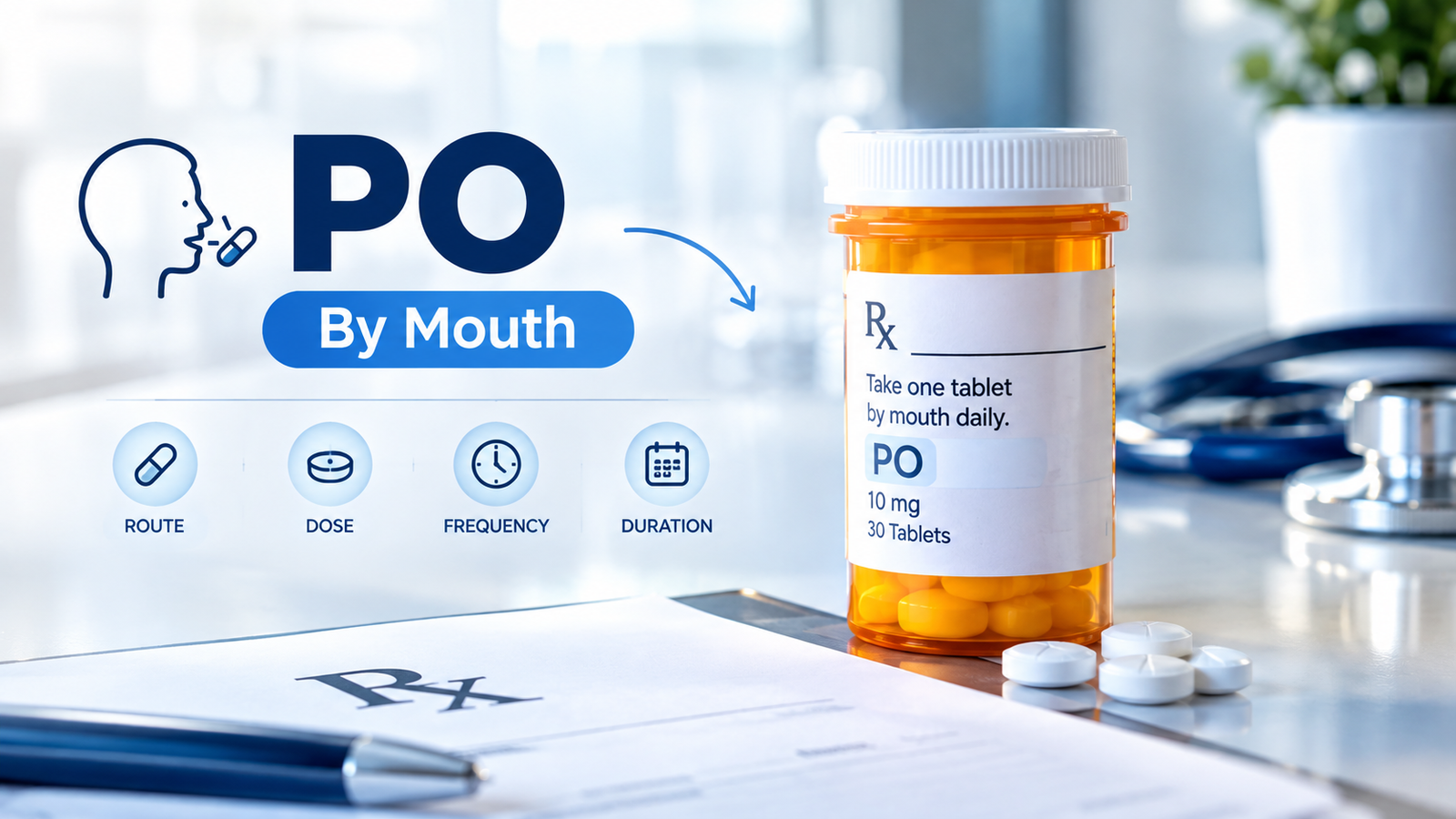
| Key takeawaysPO Medical Abbreviation: by mouth, or orally. It comes from the Latin “per os.”It’s a route instruction. It tells you how the medicine goes in, not how much to take or how often.PO doesn’t give you permission to crush, split, chew, or open a tablet or capsule.NPO is the opposite and means nothing by mouth.If swallowing is hard, ask about a liquid or dispersible version instead of altering the medicine yourself. |
You’re holding a prescription with PO on it, and you’d like to know what it’s asking you to do. PO means by mouth. It comes from the Latin phrase “per os,” and the PO medical abbreviation is one of the most common instructions you’ll find on any label, chart, or discharge note. When you see it, the medicine is meant to be taken orally, as a tablet, capsule, liquid, or lozenge.
That’s the short answer. The rest of this guide covers what PO doesn’t tell you, which matters more than most people expect.
What Does PO Mean in Medical Terms?
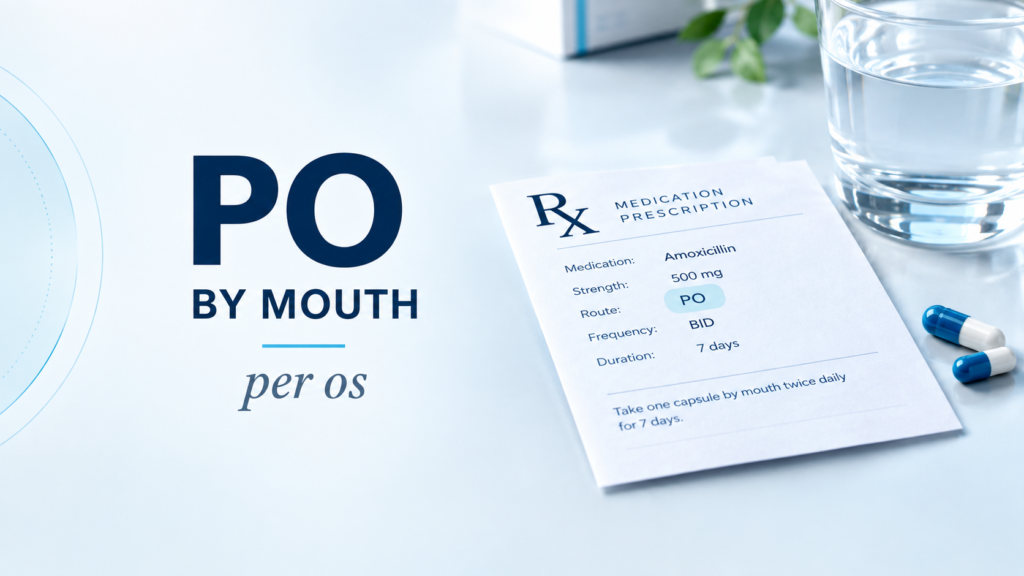
In medical terminology, PO is a route-of-administration abbreviation. You’ll see it written as PO, p.o., or P.O., and all three mean the same thing. NHS guidance lists them together as orally, by mouth, or oral administration.[4] The PO meaning medical staff use is simply the word oral in shorter form.
So if you’re trying to define PO in one sentence: the medicine goes in through the mouth, rather than being injected, inhaled, or applied to the skin. That’s the medical definition of PO. As a medical term, PO carries no other information, and the PO intake meaning refers to nothing more than that path into the body.
Why prescriptions use Latin at all
Prescription shorthand comes from a time when directions were written by hand on small paper forms. Latin contractions saved space, moved information quickly between the prescriber and the pharmacist, and made a written instruction harder for a patient to alter afterwards. Most of that shorthand survived even though the reasons behind it largely haven’t.
Modern guidance pushes the other way. Safety bodies now recommend plain English wherever it’s practical, because abbreviations that once saved a few seconds turned out to cause a meaningful share of medication errors.[6] The medical abbreviation PO itself is still considered acceptable in most prescribing guidance, but the general advice is to use less Latin shorthand rather than more.[7]
What Does PO Mean on a Prescription?
On a prescription, PO answers one question: how should this go in? It’s a single component of a longer instruction, sitting alongside separate pieces for the medicine, the strength, the amount, the frequency, and the duration.
Take a line like “Amoxicillin 500 mg PO BID for 7 days” and break it apart:
| Component | What it tells you |
|---|---|
| Amoxicillin | The medicine |
| 500 mg | The strength of each dose |
| PO | The route: by mouth |
| BID | The frequency: twice daily |
| for 7 days | How long the course runs |
Prescribing guidance keeps route, dose, and timing as separate elements on purpose, so each one can be checked on its own.[7] That’s also why the PO pharmacy abbreviation answers so little by itself. It won’t tell you the quantity, how often to take it, whether food matters, how long to continue, or what to do if you miss a dose. All of that has to come from the rest of the label.
Real Examples of PO Prescriptions
Here’s how a medication PO instruction usually shows up, and what each one is actually asking for.
| Prescription wording | Plain-language meaning |
|---|---|
| Take 1 tablet PO once daily | Swallow one tablet by mouth once a day. |
| Take 1 capsule PO BID | Take one capsule by mouth twice a day. |
| Administer 5 mL PO every 8 hours | Measure 5 mL and give it by mouth at eight-hour intervals. |
| Dissolve one lozenge PO as directed | Use the lozenge in the mouth exactly as the label explains. |
| Acetaminophen 500 mg PO PRN pain | Take 500 mg by mouth as needed for pain, within the stated limits. |
| ii tabs PO AC | Take two tablets by mouth before food. |
PO vs Other Routes of Administration
The easiest way to get a feel for the PO medical abbreviation, also called the by mouth medical abbreviation, is to see it next to the alternatives. Each one describes a different path in, and each has its own shorthand.
| Route | Abbreviation | Where the medicine goes |
|---|---|---|
| Oral | PO | By mouth, swallowed |
| Sublingual | SL | Dissolved under the tongue |
| Intravenous | IV | Into a vein |
| Intramuscular | IM | Into a muscle |
| Subcutaneous | SC, SubQ, SQ | Under the skin |
| Rectal | PR | Into the rectum |
| Inhalation | INH | Breathed into the lungs |
| Topical | TOP | Applied to the skin |
| Transdermal | TD | Through the skin, usually a patch |
| Ophthalmic | OD, OS, OU | Right eye, left eye, both eyes |
| Otic | AD, AS, AU | Right ear, left ear, both ears |
| Nasogastric | NG | Through a tube from nose to stomach |
A PO drug isn’t interchangeable with an IV or IM version of the same active ingredient. The route changes how fast the medicine acts, how much of it reaches your bloodstream, and sometimes whether that particular formulation is safe to use at all.
Why so many prescriptions say PO
Oral is the most frequently used route in clinical practice, and the reasons are practical rather than clinical. It’s convenient, it doesn’t involve needles, it needs no equipment, and it costs less to make and deliver than an injectable.[1] For most conditions where an oral option works, that’s the one you’ll be given.
PO vs NPO: What’s the Difference?
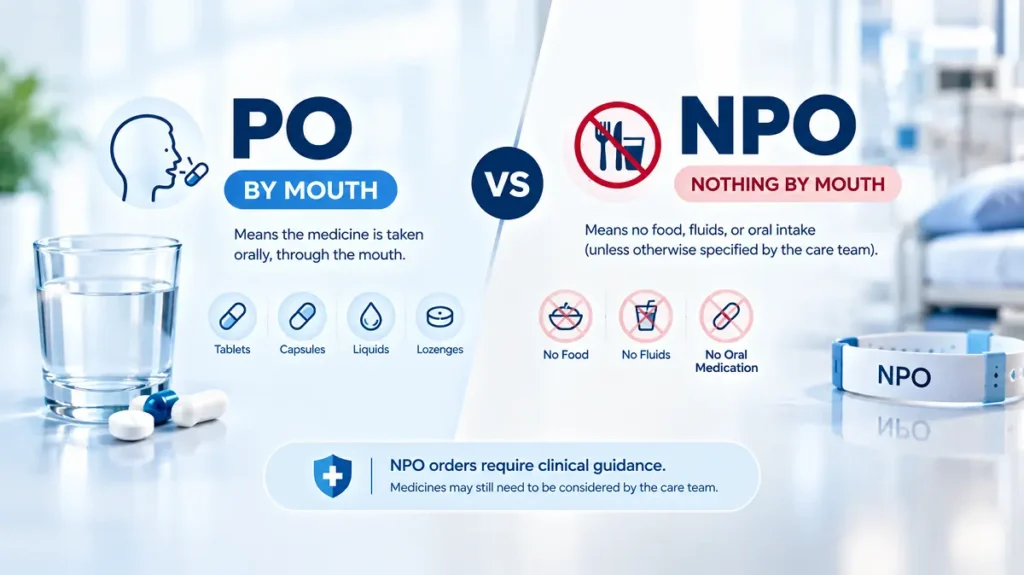
PO means by mouth. NPO means nil per os, usually explained as nothing by mouth, and NHS guidance lists it alongside the plain-English phrase nil by mouth.[4] They’re opposites, but the practical weight isn’t the same on both sides.
An NPO order isn’t just a pause on food. It’s a clinical decision made for a specific reason, like preparation for a procedure, recovery after surgery, or a risk that swallowing isn’t safe. If you’re NPO, don’t assume your usual tablets are fine with a sip of water. The care team works through each medicine and decides whether to hold it, give it with a permitted amount of fluid, switch the formulation, or use a different route entirely.
Why the Route Matters
PO is the shortest instruction on most prescriptions and the one with the least predictable outcome.
A medicine you swallow has to survive your stomach, dissolve, and cross the wall of the small intestine before any of it reaches your bloodstream. How much arrives intact, and how quickly, is called bioavailability. The formulation, what’s in your stomach, your gut, and a handful of individual factors all move that number.[3]
There’s a second loss along the way. Before an absorbed drug reaches general circulation, your gut wall and liver break down part of it, which is known as first-pass metabolism.[2] An injection skips that step, which is why the same milligram figure can mean two different things depending on the route.
None of this makes oral medicines weaker. Oral doses are set with those losses already accounted for, and plenty of PO medicines work perfectly well. What it does mean is that the route on your label is a clinical decision, not a preference, and swapping one route for another isn’t something to work out at home.
Common Misconceptions About PO
A few assumptions about the PO medical abbreviation come up often enough to correct here.
- “PO means pills only.” It doesn’t. PO covers any oral form, including liquids, suspensions, syrups, lozenges, dispersible tablets, and films that dissolve on the tongue.
- “PO means prescription only.” The letters have nothing to do with prescription status. Plenty of over-the-counter medicines are taken PO too.
- “PO means take it with water.” Water is often fine, but the abbreviation says nothing about fluid, food, or timing. Those come from a separate instruction.
- “A PO dose equals the same IV dose.” The oral and intravenous doses of the same medicine are often different numbers, for the reasons above.
When Is PO Not Safe or Appropriate?
The oral route may not work, or may need a professional assessment first, if someone:
- Has trouble swallowing or a diagnosed swallowing disorder
- Is unconscious, heavily sedated, or can’t protect their airway
- Has an NPO order in place
- Is vomiting repeatedly or can’t keep a dose down
- Has a gut condition that makes absorption unreliable or can’t safely manage a particular dosage form
Swallowing difficulty is far more common than people assume, and it isn’t limited to older patients. The NHS Specialist Pharmacy Service recommends assessing the patient, the formulation, food and fluid intake, and the administration process individually rather than applying a blanket rule.[5] If swallowing is a problem, the fix is a conversation about a liquid, dispersible, or non-oral option.
Can You Crush or Split a PO Medication?
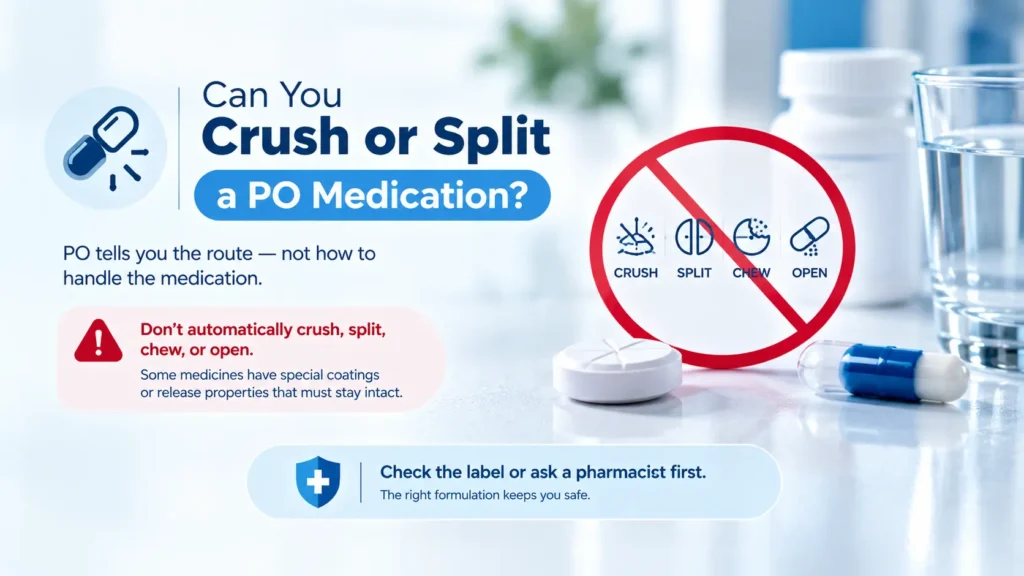
Not unless someone has confirmed it for that specific product.
A medicine can be entirely correct to take by mouth and still need its dosage form left alone. Enteric coatings are there to protect the drug from your stomach acid, or your stomach from the drug. Modified-release, delayed-release, and extended-release products are built to let their contents out slowly, and crushing one hands over the whole dose at once.
NHS medicines guidance is explicit that not every tablet can be crushed and not every capsule can be opened, and that altering the wrong one can cause toxic effects or stop the medicine working.[5] Whether a particular product can be altered depends on the brand, the strength, and the release mechanism, which is why this is a question for a pharmacist rather than a general rule you can apply.
Combination Instructions: PO BID, PO QID, PO PRN, and mg PO
Route abbreviations rarely turn up alone. They’re read as separate parts stacked together, and each part answers a different question.
| Instruction | What it means |
|---|---|
| PO daily | By mouth, once each day. |
| PO BID | By mouth twice daily. One of the most common combinations you’ll see. |
| PO TID | By mouth three times daily. |
| PO QID | By mouth four times daily, usually spread across waking hours. |
| PO PRN | By mouth as needed, within the limits on the label. |
| PO AC / PO PC | By mouth before food, or after food. |
| PO HS | By mouth at bedtime. |
| mg PO | Take the specified number of milligrams by mouth. |
| mg PO daily | Take the specified dose by mouth once each day. |
The frequency half of these carries its own detail. Three doses a day and four doses a day aren’t simply one step apart in practice, so it’s worth reading up on what TID means and what QID means separately. PRN is the one that trips people up most often, because an as-needed instruction always comes with limits the two letters don’t show.
Other Abbreviations You’ll See Beside PO
Beyond frequency, these are the terms most likely to sit next to PO on the same line. One of them, STAT, works differently from the rest: it’s a single dose given now, not a repeating schedule.
Timing and food
| Abbreviation | Meaning | Note |
|---|---|---|
| AC | Before food | May specify how long before eating. |
| PC | After food | Often used to reduce stomach irritation. |
| HS | At bedtime | From hora somni. |
| STAT | Immediately | A one-off dose, given now. |
| PRN | As needed | Only under the conditions stated. |
| UD | As directed | Follow the separate written instruction. |
Clock intervals and UK equivalents
The combination table above covers the everyday frequency terms. These are the ones that behave differently, or change form depending on where the prescription was written.
| Abbreviation | Meaning | Note |
|---|---|---|
| Q4H, Q6H, Q8H | Every four, six, or eight hours | A fixed clock interval, which may include an overnight dose. |
| Q12H | Every twelve hours | Two doses, evenly spaced. |
| BD, TDS, QDS | Twice, three times, four times daily | UK and Irish equivalents of BID, TID, and QID. |
| OD | Once daily, or right eye | Two incompatible meanings. See below. |
| QOD | Every other day | Error-prone. Should be written out in full. |
Quantity
Roman numerals still show up on prescriptions to say how many units make a dose, and NHS guidance lists them plainly: i is one tablet, ii is two, iii is three.[4] So “ii tabs PO BID” is asking for two tablets by mouth, twice a day. You may also see M/R for modified release and S/R for sustained release, both of which flag a formulation that shouldn’t be altered.
Why OD needs clarification
OD is the clearest case of one abbreviation carrying two meanings that don’t overlap. In a frequency instruction, it means once daily. In an eye instruction, it means right eye, from oculus dexter. ISMP lists OD as error-prone for exactly this reason and recommends writing “daily” for once-daily directions.[6] If the intended meaning isn’t obvious from context, check before the medicine is taken.
Why Clear Abbreviations Matter
Prescription directions are safety-critical, and the errors that happen are rarely dramatic ones. Usually it’s a letter misread, a period in the wrong place, or two terms that look alike in handwriting.
ISMP builds its list of error-prone abbreviations from terms that have been misinterpreted in reports of harmful or potentially harmful medication errors, and recommends avoiding them in handwritten, electronic, and verbal communication.[6] The spelled-out Latin “per os” is on that list because the “os” can be read as OS, the abbreviation for left eye. ISMP recommends writing PO, by mouth, or orally instead. Several frequency terms that sit beside PO are on the same list.
A few things worth doing:
- Ask for directions in plain language, like “take one tablet by mouth twice daily”.
- Check what PO is paired with: BID, TID, QID, PRN, AC, PC, or a clock interval.
- Match the medicine name, strength, route, frequency, and duration against what you were told in the room.
- Ask the pharmacy to write out any abbreviation on the label in plain English.
- Ask before crushing, splitting, chewing, opening, or mixing anything with food.
- Clarify whatever looks unclear or contradictory. ISMP recommends exactly that whenever an abbreviation could be misunderstood.[6]
Frequently Asked Questions
PO stands for the Latin per os and means by mouth, or orally. You’ll find it on prescriptions, pharmacy labels, nursing notes, and hospital charts to show that a medicine goes in through the mouth.
It tells you how to take the medicine, not how much or how often. Those come from the dose, the frequency abbreviation, and the duration written alongside it.
In practice, yes. PO in medicine is the abbreviation and oral is the everyday word for it. The dosage form still matters, since a tablet, a capsule, a solution, and a lozenge are all used differently.
The abbreviation doesn’t say. Food changes absorption for some oral medicines and not others, so follow the separate food instruction on your label or ask a pharmacist.
No. PO describes the route, not the handling. Don’t chew, crush, split, or open a product unless the label or a pharmacist confirms it’s fine for that specific medicine.
Say so, rather than altering the medicine yourself. An approved liquid, a dispersible tablet, a different formulation, or a non-oral route may be available.
Not as a rule. The oral route can have lower or more variable bioavailability because of gut absorption and first-pass metabolism, but oral doses are set with that in mind.
By mouth twice daily. PO gives the route, and BID gives the frequency. The strength, duration, and any food instructions come from the rest of the label.
PO means by mouth. NPO means nil per os, or nothing by mouth, and is used when oral intake has to be withheld. An NPO order is decided by the care team and covers medicines as well as food and drink.
References
1. Kim J, De Jesus O. Medication Routes of Administration. StatPearls [Internet]. NCBI Bookshelf. https://www.ncbi.nlm.nih.gov/books/NBK568677/
2. Drug Absorption. StatPearls [Internet]. NCBI Bookshelf. https://www.ncbi.nlm.nih.gov/books/NBK557405/
3. Drug Bioavailability. Clinical Pharmacology, Merck Manual Professional Edition. https://www.merckmanuals.com/professional/clinical-pharmacology/pharmacokinetics/drug-bioavailability
4. Understanding abbreviations in the NHS App. NHS. https://www.nhs.uk/nhs-app/help/understanding-abbreviations/
5. Choosing medicines formulations in swallowing difficulties. NHS Specialist Pharmacy Service. https://sps.nhs.uk/articles/choosing-medicines-formulations-in-swallowing-difficulties/
6. ISMP List of Error-Prone Abbreviations, Symbols, and Dose Designations. Institute for Safe Medication Practices. https://www.ismp.org/system/files/resources/2021-02/Error%20Prone%20Abbreviations%202021_0.pdf
7. Prescription Writing Quick Reference Guide. UCL and University of Manchester. https://www.ucl.ac.uk/medical-sciences/sites/medical_sciences/files/ucl-uom-prescription-writing-quick-reference-guide-v2.1.pdf
This article explains prescription notation for general information. It isn’t medical advice, and it doesn’t replace the instructions on your own prescription or the guidance of your prescriber or pharmacist. If anything on your label is unclear, ask before you take the medicine.