

The simplest answer to what is assisted living: a residential long-term care option for older adults who need daily help with personal tasks. Residents keep their own apartment, while trained staff stay on site around the clock to step in when needed.
The setting sits between living alone at home and moving into a nursing home, which provides constant medical care. Many families describe senior assisted living as the senior housing middle ground, because it adds daily support without turning a home into a hospital ward.
Each state writes its own rules for assisted living in the United States, so communities differ widely in price. Our guide walks through the services, the 2026 costs, the ways families pay, with a checklist for choosing a community at the end.
Assisted living meaning: a simple definition
The assisted living meaning comes down to housing combined with help for everyday tasks, delivered in a home-like setting. To define assisted living in a single line, it is support for daily living that still protects a person’s own choices.
Experts often call it a social model of elderly care, because the focus stays on daily life rather than medical treatment. Assisted living falls under the wider umbrella of long-term care, a field some people call elder care.
A simple assisted living description
Picture a resident with a private apartment behind a lockable door. An aide offers bathing and dressing help each morning, after which lunch is served in a shared dining room.
Why the definition of assisted living changes by state
The United States has no single federal definition of assisted living. States create their own license types, so the same kind of residential care option may carry a different name depending on where you live.
● Residential care: A broad license name several states use for assisted living.
● Assisted care: An informal term families often use for the same setting.
● Board and care home: A small house that serves a handful of residents.
● Adult foster care: Care in a family-style home, often under a separate license.
Check the state agency’s assisted living definition before you compare places. Confirm the license of every community you visit as well.
What is an assisted living facility?
An assisted living facility is the building where residents live while they receive daily support. Most residents rent a private apartment, with shared lounges for meals.
What are assisted living facilities like inside?
Many look like ordinary apartment buildings fitted with extra safety features. Apartment units often include grab bars near the bathroom, which reduce fall risk for residents with weak balance.
Each room usually has an emergency call system linked to the staff station. A personal care apartment is laid out so aides can help a resident in privacy.
How big is assisted living in the US?
The National Center for Assisted Living, the sector’s trade group, counts roughly 41,465 assisted living communities nationwide. Together these communities house more than one million Americans.
The assisted living facility definition still changes from state to state, so the services in one building may differ from those in the next. Ask each community what its state license allows before you compare prices.
How does assisted living work?
Assisted living works by matching a person’s daily needs with the care a community can safely provide. The senior care transition usually follows these six steps in order.
1. Tour several communities at different times of day to watch how staff speak with residents.
2. Complete a care level assessment, in which a nurse measures how much daily help the person needs.
3. Review the written care plan, which lists every task staff will handle each day.
4. Read the residency agreement closely, paying attention to the move-out rules.
5. Gather medical records with current prescriptions before moving day.
6. Move in, then ask staff to review the care plan after the first month.
Good care planning looks ahead, so ask whether the community can add more help as needs grow.
Many communities advertise 24-hour supervision, though that rarely means a nurse is on site at night. Ask who is in the building overnight, since the answer shapes how emergencies get handled.
What does assisted living provide?
Most communities cover personal care services, meals and housekeeping. What do assisted living facilities offer beyond that core? The answer depends on the state license as much as on each resident’s care plan.
Before you sign, ask for a written list of what services assisted living provides in that building. The list should show exactly which services the monthly fee covers.
Help with activities of daily living (ADLs)
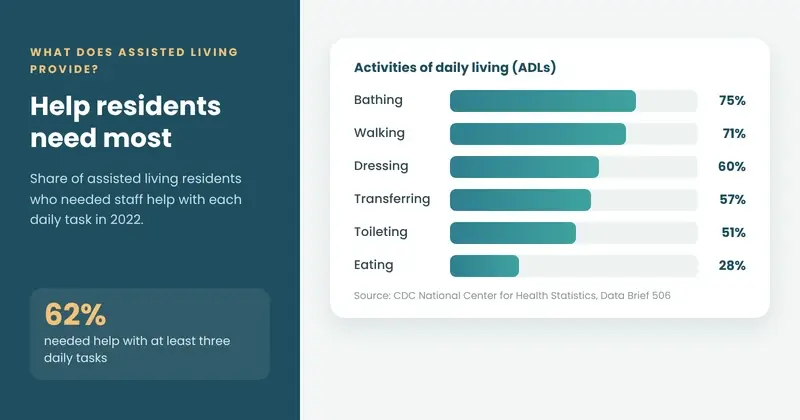
Activities of daily living are basic self-care tasks, such as eating a meal without help. ADL assistance forms the core of assisted living care.
According to the National Center for Health Statistics, about 75% of residents in 2022 needed help with bathing. Walking came next at 71%, while roughly 62% needed help with at least three daily tasks.
Personal care assistance should appear clearly in the care plan, including the time of day each task happens.
Medication management
Medication management may mean simple reminders in one community, while staff give every dose in another. State rules decide which staff members may hand out medicine, so ask who does it in each community you visit.
Health monitoring may include regular blood pressure readings by a nurse. Wellness programs such as exercise classes support senior health, though they never replace visits to a doctor.
Meals and dining services
Most communities serve three meals a day in a shared dining room. Meal preparation usually comes bundled into the monthly fee at most communities. Housekeeping services typically do too, with laundry services often included.
Good assisted living dining support goes beyond the menu. Staff should notice when a resident skips meals, since appetite changes are often an early sign of illness.
Getting around safely
Many communities run transportation services to doctor visits on a set weekly schedule. Social activities such as music sessions can lift quality of life for residents who felt isolated at home.
Emergency call systems in each apartment let residents reach staff quickly. Some communities add fall detection technology, such as elderly medical alert systems that notify staff the moment a resident falls.
What assisted living does not include
Assisted living is not the same as round-the-clock skilled nursing. Most communities do not provide IV therapy, which requires a skilled nursing setting.
Outside home health teams may still visit residents in many communities. If a resident needs more care than the license allows, the community may ask them to move.
Who is assisted living for?
Assisted living for seniors works best for people who need some daily help without constant medical care. Elderly assisted living often suits someone who has recently had a fall at home.
Loneliness is another common reason families start looking at communities. A family caregiver who can no longer keep up is often the final trigger, especially after a hospital stay.
Age alone does not decide assisted living eligibility in any state. The real question is whether a person’s needs fit what a community’s license allows.
Who lives in assisted living today
CDC figures for 2022 show that 53% of residents were 85 or older. About 67% were women, while roughly 44% lived with some form of dementia.
A dementia diagnosis does not always rule out assisted living. Residents with memory loss may still need a community with a secure memory care area.
Some younger adults with disabilities also live in assisted living settings. Involving the person in every decision protects their senior independence, which matters as much as safety.
Types of assisted living facilities
Assisted living facilities vary widely in size, with some looking like apartment complexes. Size alone says little about quality, so compare how each place handles changing needs.
Large assisted living communities
Large assisted living communities often hold dozens of private apartments. Many offer restaurant-style dining with several levels of care under one roof.
Residential assisted living in small homes
Residential assisted living usually takes place in a regular house in a neighborhood, often with fewer than ten residents. Some states call these settings an adult family home, while others use the term small residential care home.
Memory care assisted living
Memory care assisted living serves people with Alzheimer’s disease. Memory care areas typically have secure doors, with staff trained in dementia care.
Continuing care retirement communities
A continuing care retirement community offers several levels of care on one campus, including a nursing wing for residents with medical needs. Residents can move between levels as needs change, without leaving familiar surroundings.
Assisted living vs other senior care options
Families asking what is assisted living usually want to know how it compares with other choices. Choosing among senior living options depends mostly on how much daily help a person needs. The table below compares the main choices side by side.
| Option | Level of support | Setting | 2025 median cost | Who usually pays |
| Assisted living | Daily personal care with some health support | Apartment in a community | $6,200 a month | Mostly private pay, some Medicaid |
| Nursing home | 24-hour skilled nursing care | Licensed nursing facility | $114,975 a year (shared room) | Medicaid, private pay, Medicare for short rehab |
| Memory care | Dementia care in secure areas | Secure unit | Assisted living rate with an added fee | Mostly private pay |
| Independent living | Housing without daily care | Retirement community | Varies by community | Private pay |
| Home care | Help inside your own home | Private home | About $35 an hour | Private pay, some Medicaid programs |
Assisted living vs nursing home
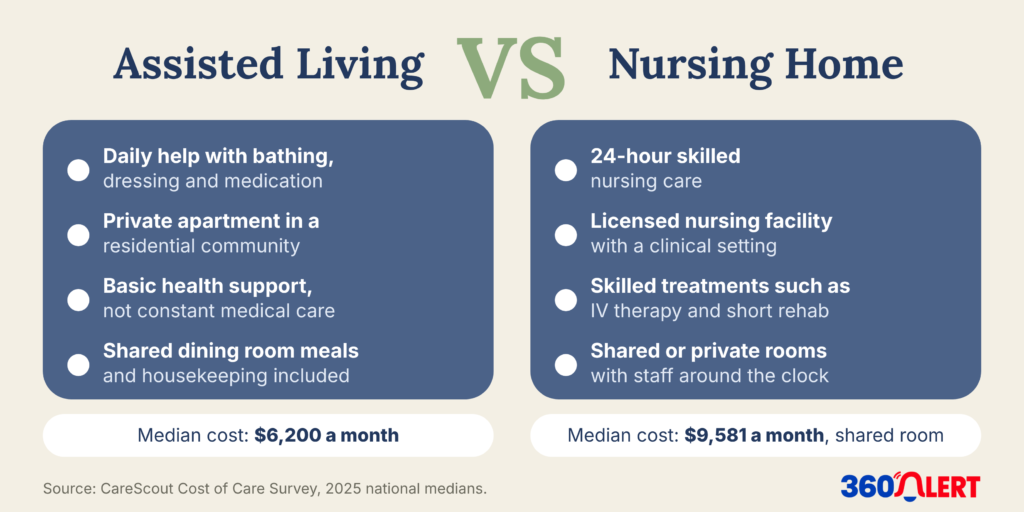
An assisted living nursing home comparison shows one main difference. Nursing homes deliver skilled nursing around the clock, while assisted living focuses on daily support in a home-like setting.
Assisted living vs independent living
Independent living suits seniors who need no help with daily tasks. Assisted living adds personal care with supervision, so some campuses offer both to let residents switch later.
Assisted living vs memory care
Memory care is a specialized form of care for people with dementia. Compare staff training with the daily activity schedule before you choose between the two.
Assisted living vs home care
Home care brings caregivers into a person’s own home, which supports aging in place. An AARP survey found that 75% of adults over 50 want to stay in their current homes as they age.
Assisted living becomes an aging-in-place alternative once a person needs more support than home care can give. Compare the total monthly cost of each option before deciding.
Levels of assisted living care
Assisted living care has no national numbering system for levels. Many communities still group residents by level of care, with the monthly fee rising at each step.
One community’s level 2 may not match another community’s level 2. Ask for the written list of tasks in each level, since the labels mean little on their own.
How much does assisted living cost?
The national median cost of assisted living reached $6,200 a month in 2025, which works out to $74,400 a year. The figure rose 5% from the year before, according to the CareScout Cost of Care Survey, formerly the Genworth Cost of Care Survey.
A shared nursing home room cost a median of $114,975 a year in 2025, with a private room at $129,575. Assisted living costs depend mostly on location, with care level close behind.
Common pricing models
Communities price care in three main ways, so ask which model applies before comparing quotes.
| Pricing model | How it works | Question to ask |
| All-inclusive | One monthly fee covers a set package of services | Which care tasks fall outside the package? |
| Tiered | Base rent with a care fee that rises by level | What tasks define each level? |
| A la carte | Separate charges for each service used | What will my total be each month? |
Get a full assisted living cost breakdown
Ask for a written estimate that lists every charge before you sign.
● Monthly rent: The base price for the apartment itself.
● Care level fees: Charges that rise as daily help increases.
● Medication support: Often billed separately from personal care.
● Move-in fees: One-time community fees with deposit refund terms.
● Yearly increases: The typical annual rate rise in recent years.
Request two written estimates, the first for today’s needs, the second for one higher level of care.
Who pays for assisted living?
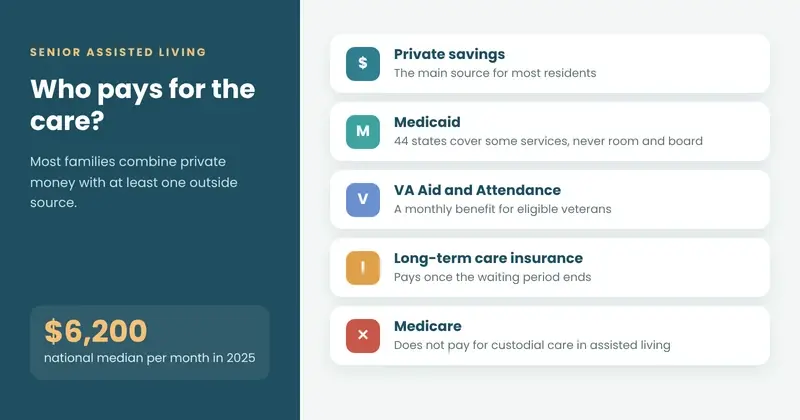
Most families pay for assisted living with private savings or income. Several other sources can cover part of the bill.
● Medicare: According to {Medicare.gov|MCARE}, Medicare does not pay for long-term custodial care such as assisted living. Medical services like doctor visits remain covered under the usual Medicare rules.
● Medicaid: The {Government Accountability Office|GAO} found that 44 states covered some assisted living services through Medicaid as of March 2025. Even under these programs, Medicaid never pays for room and board.
● VA benefits: Eligible veterans may qualify for the {VA Aid and Attendance|VA} benefit, a monthly payment toward care costs.
● Long-term care insurance: Many policies cover assisted living once a waiting period ends.
● Tax deductions: Some care costs count as medical expenses under {IRS Publication 502|IRS}.
About 17% of residents relied on Medicaid for some services in 2022. Many waiver programs have waitlists, so apply early through your state Medicaid agency.
Assisted living regulation basics
Assisted living regulation basics start with the state license, which sets the rules for staffing. Assisted living has no federal staffing standard, unlike nursing homes, which follow federal rules.
Ask the state licensing agency where to find recent inspection reports. Inspection reports list complaints that a guided tour will never reveal.
A community can ask a resident to leave only for reasons listed in the contract or state law. Notice periods vary by state, so read that clause before you sign.
The Long-Term Care Ombudsman Program helps residents with complaints in every state, including Washington, D.C. Discharge disputes rank among the most common problems ombudsmen handle in assisted living.
What is assisted living like day to day?
A typical day in an assisted living community follows a relaxed routine. A resident might get help dressing after waking, then join neighbors for breakfast in the dining room.
Mornings often bring an exercise class, with short outings filling the afternoon. Staff hand out evening medicine after dinner, though residents should still set their own schedule wherever possible.
Ask whether pets are allowed before you move, since rules differ widely. Talking with current assisted living residents during a visit shows what daily life is really like.
Benefits of assisted living
Families usually weigh these assisted living benefits first.
● Daily help: Staff assist with personal care every day.
● Safer living space: Rooms are built to lower fall risk, with help available at any hour.
● Regular meals: Residents eat balanced meals without having to cook.
● Social life: Group activities can ease loneliness.
● Caregiver support: Relatives can step back from daily care to spend better time together.
Assisted living also carries real trade-offs that families should weigh. Monthly costs exceed staying at home for many families, while some residents feel they have less privacy than before.
How to choose an assisted living community
Visit at least two or three assisted living communities with the same list of questions.
7. Ask which staff are on site during each shift, including overnight.
8. Ask who completes the care level assessment.
9. Ask what the base fee includes.
10. Ask what happens when a resident falls at night.
11. Ask about rate increases over the last three years.
12. Ask where you can read the state license.
During each tour, notice whether staff speak to residents with respect. Compare the written care plan with the total monthly estimate, not only the advertised starting price.
Conclusion
Understanding what is assisted living starts with one idea: housing with daily support, not a hospital. Residents get help with personal care while keeping their own space, with trained staff available at any hour.
The right fit depends on the person’s needs, measured against the family budget. With a 2025 national median of $6,200 a month, plan payment early, since Medicare does not cover room and board.
List the help your loved one needs today, then compare costs across several communities. Read the state inspection reports before touring your top choices together.
Frequently asked questions
Assisted living for seniors combines housing with help for daily tasks like bathing. The option suits older adults who need more help than independent living offers but less than a nursing home provides.
Assisted living facility care is the daily support a licensed community gives its residents, usually personal care with meals. The exact services depend on each resident’s care plan.
Most assisted living facilities include a private apartment with three meals a day. Housekeeping is usually part of the monthly fee as well.
For families, assisted living means a loved one gets daily help in a safe setting with trained staff. Relatives still play a key role by joining care plan meetings when needs change.
Assisted senior living is another name for assisted living, often used in marketing. Senior assisted living facilities offer the same mix of housing with daily personal care.
Medicare does not pay for room and board in assisted living. Medicare may still cover medical services such as doctor visits while a person lives there.
Overnight staff usually handle safety checks with emergency response through the call system. Ask each community how many staff work overnight, because night staffing varies widely between buildings.
Nurse requirements depend on the state where the community operates, since no national rule demands one in every building. Some communities keep a nurse on site all day, while others rely on a nurse on call.
