
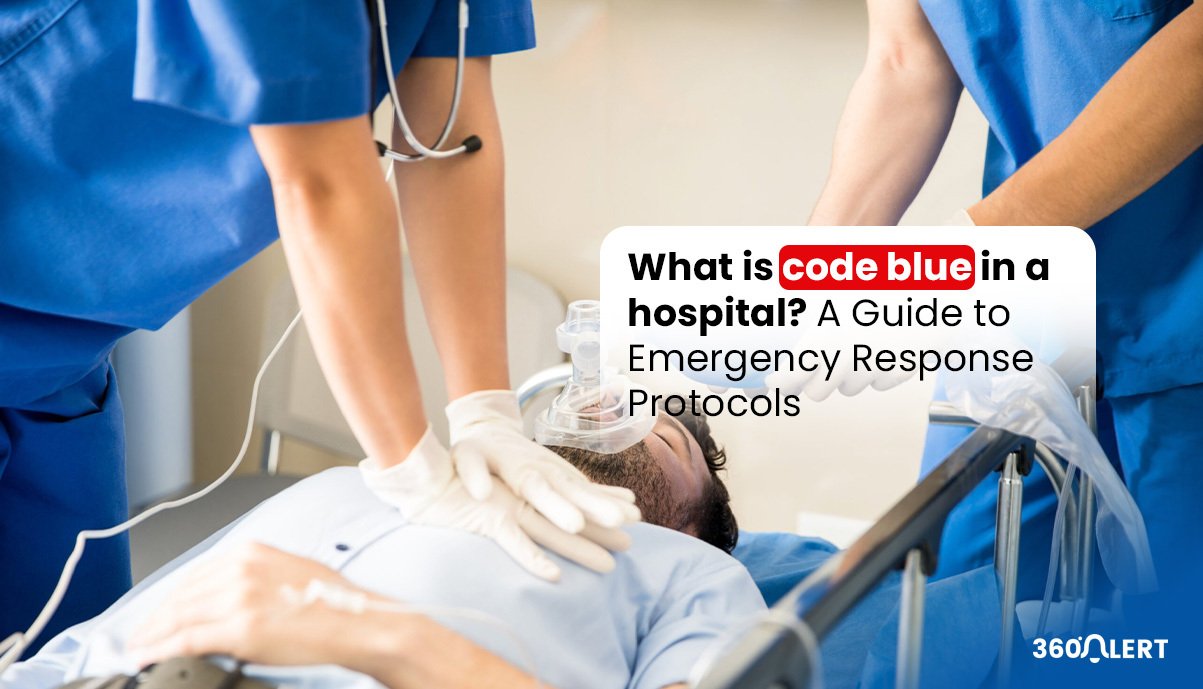
Imagine sitting in a hospital waiting room when suddenly, the overhead speaker crackles to life: “Code Blue, Emergency Department, Room Three.” Instantly, you can sense a surge of focused urgency among staff as nurses and doctors rush from all directions. Hearing “code blue” in a hospital marks one of the most serious medical emergencies—a clear sign that a patient is in cardiac arrest or respiratory failure. How hospital staff reacts in the first few seconds can be life-saving.
This guide will help hospital staff, clinicians, patients, and families understand exactly what happens during a code blue: what it means, how to respond, what to expect next, and essential steps to improve outcomes. Whether you want to support a loved one, learn your role as a medical professional, or simply understand hospital procedures, you’ll find clear answers and practical advice inside.
What Does Code Blue in a Hospital Mean?
The code blue alert is a standard medical emergency signal used in hospitals, healthcare facilities and other institutions around the world. A code blue alert is issued when a person experiences a sudden cardiac event, stops breathing or enters a state of unconsciousness requiring immediate medical intervention.
The term “code blue” comes from the color-coded alarm systems that most hospitals employ to communicate different types or emergencies without causing panic amongst visitors and other patients. Although color codes vary slightly from facility to facility, code blue almost always signifies a cardiac or breathing emergency.
A code blue call is a signal to a resuscitation crew to rush to the location of the patient. They are equipped with defibrillators, crash carts, medications and the expertise needed to perform CPR, advanced management of airways and other lifesaving procedures.
What Triggers A Code Blue In A Hospital?
Not every medical condition will result in the activation of a Code Blue. The activation criteria have been designed to help identify patients at risk of collapse or those who already have.
Common Code Blue activation criteria
| Cardiac Arrest | Heart stops pumping effectively; no pulse detected |
| Respiratory arrest | Patient is unable to breathe or their breathing is critically inadequate |
| Severe Unconsciousness | Unresponsive to voice or Physical Stimulation |
| Extreme Hypoxia | Oxygen saturation levels drop to dangerously low levels despite intervention |
| Uncontrolled Seizures | Airway obstruction or circulation compromised by prolonged seizure activity |
| Sudden Neurological Collapse | Rapidly onset inability to respond with no simple cause |
Anyone who is a nurse, doctor or trained member of staff and witnesses any of these situations can make a code-blue call. Rapid response system in the hospital activates instantly upon announcement.
Who Responds to Code Blue in the Hospital?
A team effort is required to respond in a code blue situation. Modern hospitals have dedicated code-blue teams, or “crash team” teams that are always on call. The multi-disciplinary nature and complexity of resuscitation is reflected in the composition of this team.
Members and roles of the Code Blue Response team
| Attending physician or hospitalist | Leads resuscitation and makes clinical decisions |
| Cardiologist | Manages cardiac-specific interventions |
| ICU/Critical-Care Nurse | Monitor vital signs, administer medication |
| Respiratory Therapist | Manages ventilator, oxygen, and airway support |
| Anesthesiologist | Handles advanced airway management and intubation |
| Pharmacist (in larger hospitals) | Prepare and check emergency medications |
| Charge Nurse | Coordinates the room, documentation, communication, and coordination |
| Code Team Runner | Retrieves equipment and relays information |
| Security or Ancillary Personnel | Controls crowd and maintains clear access into the room |
In smaller or more rural hospitals, a team might be smaller but the roles will remain the same. The roles are just shared by fewer individuals. Simulation drills and training prepare the staff for such flexible deployment.
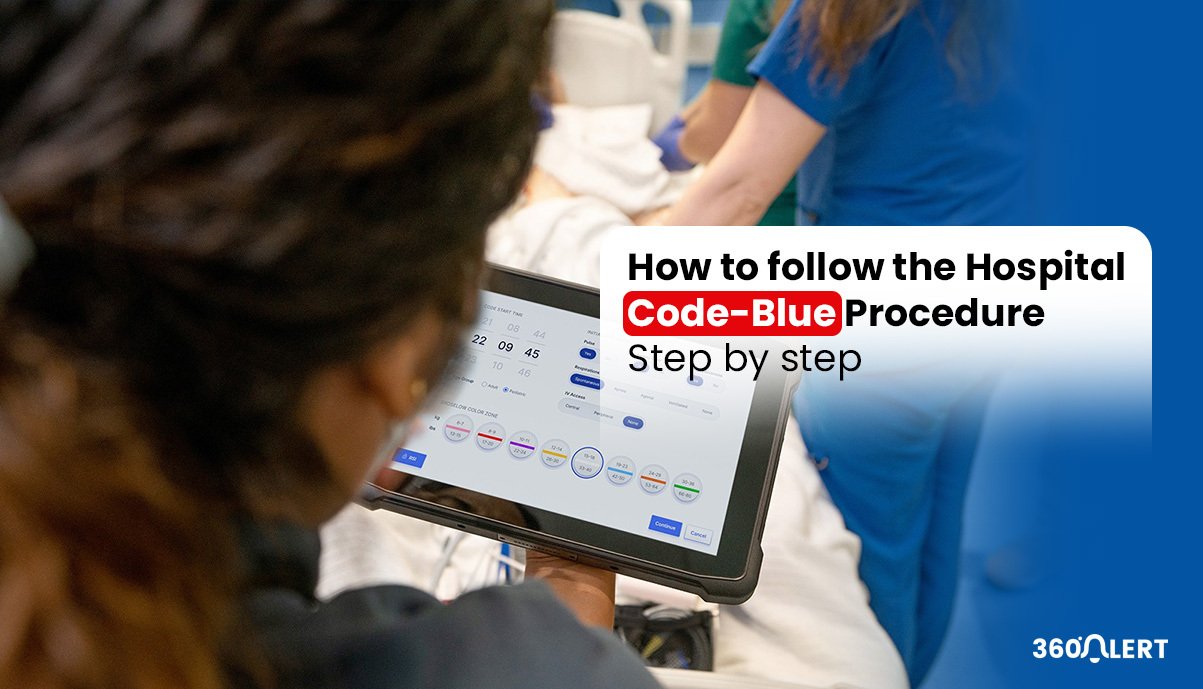
How to follow the Hospital Code-Blue Procedure: Step by step
Understanding what happens during a code-blue helps demystify an event that can seem chaotic. In reality, the process is highly choreographed.
Code Blue: Step-by-step response
First Step — Recognize and Announce Staff member determines the patient to be unresponsive. They call for assistance and start the hospital code-blue announcement system. This can be done via phone, intercom or digital alert. The announcement also includes the location of the patient.
Step 2- Begin Basic Support Life (BLS) Immediately, the first responder to arrive on scene — usually the nurse by your side — will begin CPR. The chest compressions must be done at the right rate (100-120 per min) while another member of the staff gets the crash cart and the defibrillator.
Code Team Arrives In minutes (hospitals usually target a 2 to 3 minute response time), the dedicated code blue team will arrive. The leader of the team takes charge, assigns responsibilities, and assesses a patient’s condition.
ACLS (Advanced Cardiovascular Life Support) This is the team’s transition from basic resuscitation to advanced resuscitation. This includes intubating the patient’s airway, analyzing their heart rhythm, and administering emergency drugs such as atropine, amiodarone or epinephrine depending on their rhythm.
Step 5- Defibrillation When the cardiac monitor indicates a shockable heart rhythm (ventricular fibrillation, VF), or pulseless ventriculo-atrial tachycardia, VT), the defibrillator will deliver an electrical shock that resets the rhythm.
Step 6 — Continuous Monitoring The team alternates between CPR, rhythm check, medication administration, defibrillation, and other procedures at structured intervals. The team leader constantly reassesses patient and adjusts approach.
STEP 7 — Return to Spontaneous circulation (ROSC), or Termination The patient will achieve ROSC if resuscitation has been successful. He/she is then stabilized to be transferred to the ICU. The team leader will call the code when all interventions fail and the clinical situation is hopeless after a certain period of time.
Documentation and debriefing Every detail of what happened is meticulously recorded. This includes timing, medications and interventions. Many hospitals have a post code debriefing in order to review performance, identify areas of improvement and assess the effectiveness.
What is different about Code Blue?
The ICU is a unique environment. ICU patients often have severe illnesses, are on ventilators and continuous cardiac monitoring. They may also be receiving complex medication infusions. ICU staff are more prepared to handle an incident than those in a general hospital, and they may even be anticipating it.
The ICU is a place where the primary nurse can often start resuscitation in a matter of seconds. This is because the patient’s condition is monitored continuously. The crash cart should always be close by. ICU Code Blues are different because they may require more nuanced decisions, such as DNR (Do Not Resuscitate orders) or advanced directives which limit the scope for intervention.
Code Blue vs. other hospital emergency codes
Color-coded alerts are used by hospitals to efficiently handle various emergencies. Understanding code blue’s role in the broader system will help clarify when it is used.
Hospital Emergency Code Comparison
| Code Blue | Cardiac/Respiratory Acute Arrest | Resuscitation team |
| Code Red | Fire | Evacuation, fire team |
| Code Black | Bomb Threat | Security, evacuation |
| Code Grey | Security Threat/Combative Person | Security and law enforcement |
| Code Orange | Hazardous Material Spill | Hazmat team isolation |
| Code Pink | Baby/child abduction | Lockdown security |
| Code Silver | Active Shooter or Weapon | Lockdown by law enforcement |
| Code White | Pediatric Emergency | Pediatric Response Team |
Not all hospital systems or countries have a standardized code system. Some facilities use plain English alerts rather than color codes. The code blue designation is still widely used in the healthcare industry.
Code Blue in Pediatric hospitals: Key differences
When a code-blue occurs in a child’s setting, protocols must take into consideration the significant physiological differences that exist between children and adults. Weight-based medication dosages, varying equipment sizes, and intense emotional dynamics among families all play a role in determining the protocol for a code blue.
Children’s code blue teams receive training in pediatric advanced Life Support (PALS), a technique that addresses the most common causes for cardiac arrest in children – respiratory failure or shock rather than primary heart disease, which is more common in adult patients.
Hospitals with children’s units have airways that are sized appropriately, crash carts designed for pediatrics, Broselow color-coded tapes to quickly measure doses based on weight, and staff who know how to communicate with parents sensitively in an emergency.
What nurses must know about Code Blue nurse responsibilities
Nurses are the first to recognize that a patient is deteriorating and will initiate a Code Blue. Their responsibilities continue throughout the process of resuscitation.
Nursing Responsibilities in a Code Blue
| Recognition | Assess patient and call for help. Start CPR |
| Early Response | Attach defibrillator to crash cart and set up IV access |
| Code | Rotate compressions and rotate medications. Document the timeline. |
| Communication | Update the team leader with patient history |
| Family Support | Staff member assigned to family members |
| Post-Code | Documentation, transport of patients, participation in debriefing |
Due to the high risk environment, nurses in areas with high-acuity such as ICU, the emergency department or the cardiac care unit are given more code blue simulations.
Hospital Code-Blue Training and Simulation Guideline
The cornerstone of an effective code-blue response is preparedness. Hospitals invest heavily in training programs, because the quality and performance of the team directly affects the patient outcome.
American Heart Association guidelines on Advanced Cardiovascular Life Support, or ACLS, are the basis for modern code blue training. These guidelines are updated frequently and cover CPR mechanics, post-resuscitation treatment, and more.
The use of high-fidelity models allows teams the opportunity to train in realistic situations without risking real patients. These simulations are capable of recreating a variety of scenarios such as cardiac arrest in hospital, difficult breathing situations and pediatric codes.
Many hospitals conduct “mock-code” drills, which are unannounced simulations of actual patient floors, to test response times and team communication. They also check equipment readiness. Research has shown that code-blue simulations improve real-world results.
Code Blue Training Components
| ACLS Certification | Standardizes the knowledge and skills of resuscitation |
| High-Fidelity simulation | Team coordination and muscle memory is improved. |
| Mock Code Drills | Tests for real-world readiness, response time and ability |
| Debriefing sessions | Finds gaps in the system and reinforces existing best practices |
| Role Specific Training | Every team member should know their specific role |
| Communication Training | Improves closed-loop communication under pressure |
What Happens When a Code Blue is Issued?
Regardless of the outcome, the immediate post-code blue period is one of intense clinical activity. If the patient is able to survive (accomplish ROSC), intensive monitoring will be required in the ICU. This includes temperature control and neurological assessment.
If the patient doesn’t survive, the team shifts to another but equally vital mode of care: supporting the family and completing the legal documentation.
The post-code discussion is now the standard of care for hospitals with high performance. These structured discussions review what went right, what can be improved, as well as how the team has communicated. The debriefing process improves performance in the future and helps staff to deal with emotional stress after a failed attempt at resuscitation.
Current Code Blue Systems: Pros and Cons
| Standardization | Uniform response protocols improve efficiency | Color codes differ between hospital systems |
| Team-Based response | Multi-disciplinary approach enhances outcomes | Under pressure, coordination between teammates can breakdown |
| ACLS Guidelines | Regularly updated and evidence-based | Not all treatment plans are suited to specific patient groups |
| Simulation Training | Building confidence and competency | Not all hospitals can afford to use high-fidelity simulation |
| Rapid Response | Fast activation saves lives | Response times may vary depending on hospital size and layout |
What Code Blue means to patients and their families
The emotional and physical healing of patients who have been through a code red and survived can be profound. Many survivors suffer from post-intensive treatment syndrome (PICS). This can include cognitive problems, anxiety, deconditioning, and depression.
The experience of a family witnessing or hearing a code-blue is terrifying. It is important that hospital staff communicate clearly and with compassion. There are many hospitals that offer a family presence policy during resuscitation. The research shows it helps families cope and does not compromise team performance.
It is important to understand advance directives if you are admitted to hospital or your loved one. These documents specify the type of interventions they would like or not want. DNR orders (Do not Resuscitates) mean that code blue will not be used if cardiac arrhythmia occurs. The healthcare providers should be informed of these decisions well before a crisis occurs.
Code Blue Hospitals – Frequently asked questions
Is a Code Blue a life-threatening situation that requires immediate resuscitation? The code blue alert is used by hospitals to signal that a person is in cardiac arrest or respiratory arrest. It activates a team of professionals trained in advanced medical support.
What is the duration of a Code Blue? This depends on how the patient responds. Most resuscitations last 20-30 mins before the team leader decides whether or not to continue. Resuscitation may be extended in some cases, especially if the cause of death is reversible.
What’s the survival rate of a code-blue in a hospital? Recent studies suggest that 20-25% patients who suffer a cardiac event in hospital survive until discharge. The survival rates are higher if an arrest is observed, if CPR bystanders is administered quickly, and if there is a shockable heart rhythm.
Are family members allowed to be in the room during code blues? Some hospitals will allow family members present to help with resuscitations if a family member has been designated to do so. The presence of family members does not impact team performance. It may even help families process the event.
Is there a difference between code-blue and rapid response? When a patient’s condition is deteriorating, but he hasn’t yet stopped breathing, a rapid reaction (sometimes called code early or code Medical Emergency Team — Medical Emergency Team), will be activated. It is proactive to prevent the full code-blue. A code blue is a sign that arrests have already taken place.
Can anyone in the hospital call for a code-blue? A hospital employee, such as a nurse, technician, doctor or an informed patient, can activate a code-blue by calling an operator or pressing the emergency alert button. The early activation of a code blue is preferred to a delayed response.
In a code Blue, what medications are commonly used? Epinephrine or adrenaline (adrenaline) is the most common medication used. Amiodarone and lidocaine can be used for arrhythmias. Sodium bicarbonate can be used for acidosis. Atropine may also be used in some bradycardia cases. All medications follow ACLS protocols and are weight adjusted for pediatric patients.
Understanding Code Blue: What it means to you
A code-blue in a medical facility is medicine at its most critical — a race with time to restore the life of a patient. Healthcare professionals are required to make split second decisions, work flawlessly as a team, and undergo continuous training. Code blue can be a source of anxiety for patients and their family members. By understanding the meaning, it helps to reduce this fear and facilitates more informed discussions about care preferences and advanced directives.
Trusted Resources
Centers for Disease Control and Prevention
- The CDC has guidelines and protocols relating to public health including emergency medical situations such as code blue in hospital.
- NIH provides authoritative medical research, resources and studies on emergency situations like heart attack and respiration failure.
Health Resources and Services Administration
- HRSA oversees health services, emergency care training and protocols for code blue situations.
- NLM offers resources such as PubMed to research medical emergencies. This includes code blue, and related resuscitation protocol.
U.S. Department of Health & Human Services
- The HHS is responsible for national healthcare policies, emergency medical practices and Code Blue protocols in hospitals.